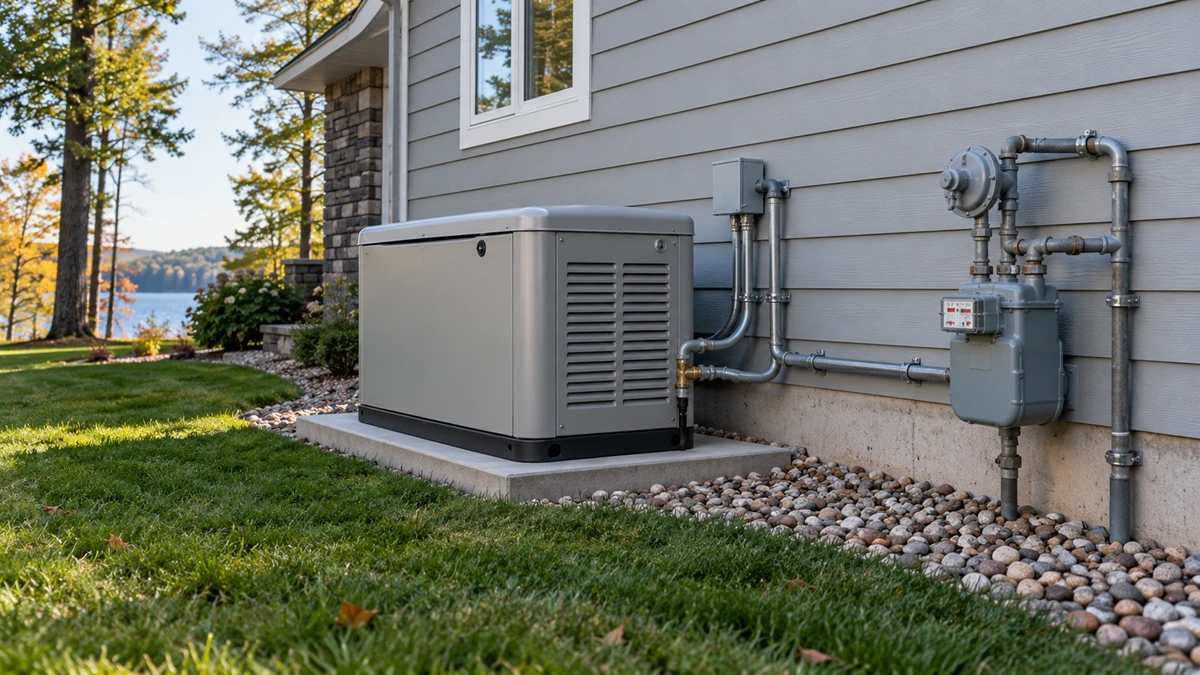

Do I need to upgrade my gas meter for a generator? Yes, when the generator and your other gas appliances together can draw more gas than the meter can deliver. A natural gas standby generator is a large new gas load, and many residential meters were sized for a furnace, a water heater and a range. Meyers Electric installs Cummins standby generators in Rice Lake and across northwest Wisconsin, and your gas utility makes the final call on the meter.
What is a Natural Gas Generator?
A natural gas generator is an engine-driven generator that burns piped natural gas to make electricity. A standby model sits outside, ties into your gas line and your electrical panel, and starts on its own when utility power fails. It never needs hand refueling, because the gas main is the fuel supply.
Gas supply is the feature and the limit. You never run to the store for fuel in a January ice storm. The unit also depends on the pipe, the regulator and the meter delivering enough gas on the day you need it.
What parts make up a natural gas standby system?
Five parts matter for the meter question. Each one either uses gas, controls gas or moves power.
| Part | What it does | Why it matters for the gas meter |
|---|---|---|
| Engine | Burns natural gas to spin the alternator | Sets the gas demand, in cubic feet per hour |
| Alternator | Turns engine motion into electricity | Output in kW sets the engine load |
| Automatic transfer switch | Moves your home between utility and generator power | Starts the engine when power drops |
| Fuel regulator | Holds gas pressure steady at the engine inlet | Must match the supply pressure from your line |
| Gas line and meter | Carry gas from the utility main to the engine | Must flow the full load without a pressure drop |
How does a natural gas generator work?
An automatic transfer switch watches utility power. When power drops, the switch signals the engine to start, then moves your home onto generator power within seconds. When utility power returns, the switch moves the load back and the engine stops. Our guide to a generator that starts automatically covers the sequence in detail.
The gas side works in the background. The moment the engine fires, it pulls its full demand through your meter. A meter that is too small shows up here, as a pressure sag at the engine and the furnace.
Can a generator run on natural gas if it is portable?
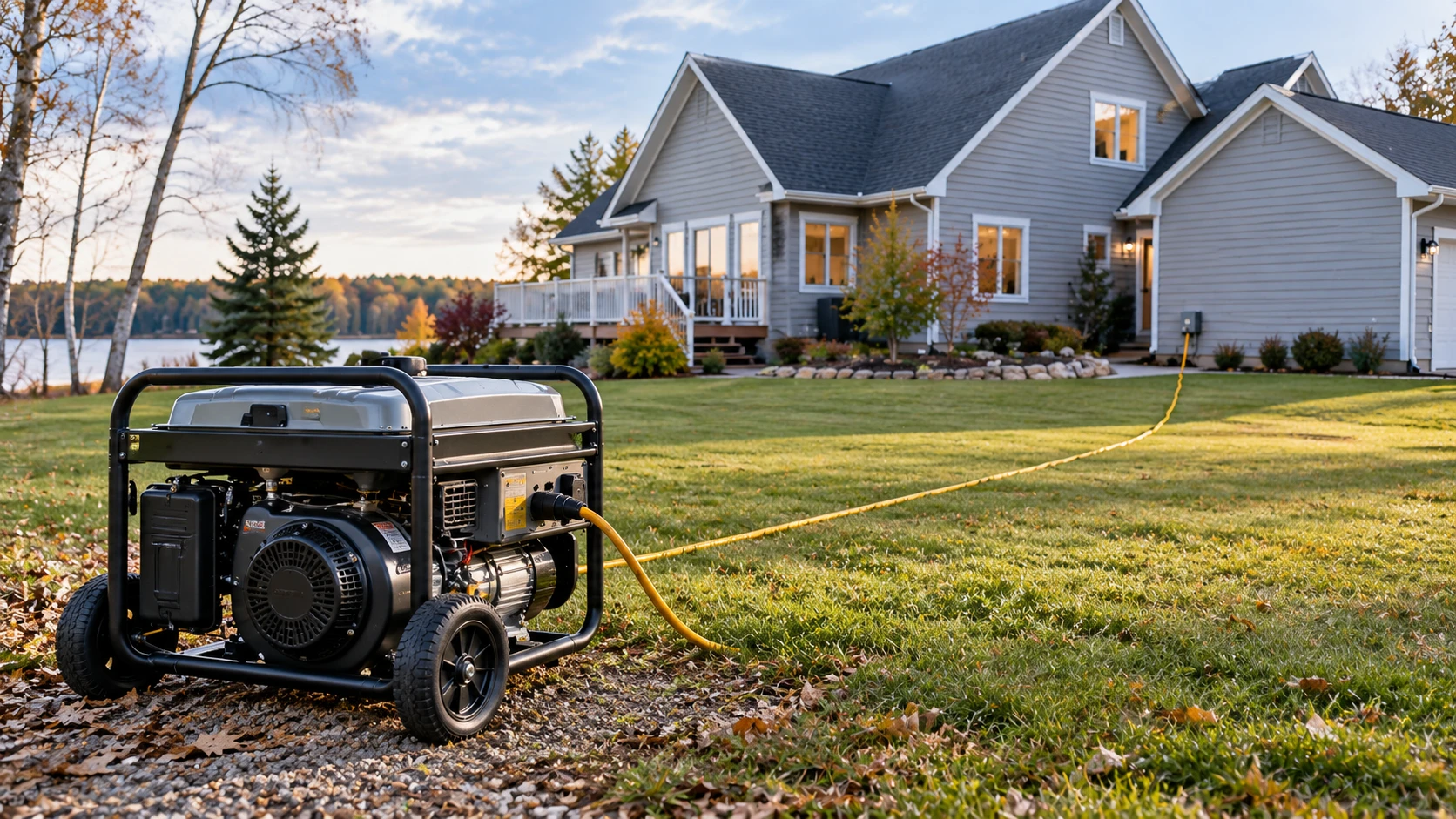
Most portable generators do not connect to a home gas line. The Meyers Electric portable lineup runs on gasoline or dual fuel (gasoline or propane). Natural gas generators are standby units. Some standby models accept natural gas or propane, and the fuel is set at install.
Fuel changes output. Cummins lists the RS20A at 18 kW on natural gas, below its LP rating, per a retailer listing of Cummins specs. Size the unit for the fuel you will use.
When do you need to upgrade your gas meter for a generator?
You need a meter upgrade when the generator plus your existing gas appliances can draw more than the meter’s rated capacity. The rating is printed on the meter, in cubic feet per hour. The gas utility reviews your load and decides what changes.
Start with the scale. The Sensus R-275, a residential diaphragm meter, is rated at 275 cubic feet per hour of natural gas. A 25 kW Cummins RS25 uses about 310 cubic feet per hour at full load, per Cummins data. The generator alone passes the rating of that meter before the furnace comes on.
Other utilities publish rough rules that show the same pattern:
- A Nicor Gas representative told Patch that generators above about 8 kW usually need a larger meter in its Illinois territory.
- A New York town requires a meter upgrade at 350,000 BTU of connected load or more, per Perinton’s generator rules.
Those are not Wisconsin rules. Your own utility sets yours, and the call to make is the same one: tell them the generator model before you buy.
Which situations almost always trigger a meter review?
Four situations send a generator job to the gas utility. Check them against your own property.
- A generator of 20 kW or more. Its full-load demand sits at or near a standard residential meter’s whole rating.
- A gas-heavy home. A gas furnace, water heater, range and dryer already use a large share of the meter.
- A long service line. Distance from the main to the house adds pressure loss before the meter.
- A second building. A shop, barn or guest cabin on the same meter adds its own gas load.
When can you skip the upgrade?
A smaller generator on a lightly loaded home can fit the existing meter. Nobody should assume that. The utility confirms it from the generator’s gas demand and your appliance list. A short request now costs far less than a stalled install.
From the Meyers Electric crew: Generator jobs start with load analysis and permitting, before any equipment is ordered. The gas meter question goes on that same checklist, so the utility hears about the generator early.
How do you check if your meter can handle a generator?
Compare total gas demand to your meter’s rating. One cubic foot of natural gas holds roughly 1,000 BTU, so a meter rated in cubic feet per hour converts straight to BTU per hour. Your bill shows the exact heat content.
- Read the capacity on the meter plate, in cubic feet per hour.
- List every gas appliance and its input rating in BTU per hour. The nameplate shows it.
- Add those ratings together.
- Find the generator’s full-load gas use on its spec sheet and add it.
- Compare the total to the meter capacity.
Here is a worked example with made-up appliance ratings, for illustration only:
| Load | BTU per hour | Cubic feet per hour |
|---|---|---|
| Furnace | 100,000 | 100 |
| Water heater | 40,000 | 40 |
| Range | 65,000 | 65 |
| Dryer | 25,000 | 25 |
| Appliance total | 230,000 | 230 |
| 25 kW generator at full load | 310,000 | 310 |
| Combined demand | 540,000 | 540 |
A 275 cubic feet per hour meter cannot carry 540. In practice, utilities apply their own method, since a home never runs every appliance at once. Your utility sizes the fix. Do not guess at it, and do not rely on a spreadsheet you built.
Where do you find the numbers?
The numbers sit in three places.
- Meter plate: Capacity in cubic feet per hour, on the meter face.
- Appliance nameplates: Input rating in BTU per hour, on a sticker near the burner or inside the door.
- Generator spec sheet: Fuel use at half and full load, on the manufacturer’s data sheet. Meyers Electric pulls the sheet for the exact unit you are quoted.
Do not confuse the gas meter with the electric meter. A different question, whether you need a new electric meter, covers the service on the electrical side.
How much natural gas does a generator use?
A standby generator burns far more gas at full load than at half load. A 25 kW Cummins RS25 uses about 310 cubic feet of natural gas per hour at full load, per Cummins emissions data. A real outage rarely loads the generator fully, so actual use runs lower.
| Cummins model | Half load | Full load | Source |
|---|---|---|---|
| RS20A (18 kW on natural gas) | 135 cu ft/hr | 240 cu ft/hr | Retailer listing of Cummins specs |
| RS25 (25 kW) | 186 cu ft/hr | 310 cu ft/hr | Retailer listing and Cummins data |
Each model’s spec sheet lists its own consumption. Use the sheet for the unit you are buying.
How much gas does a generator burn in a day?
Multiply cubic feet per hour by 24. For the RS25, that math gives these figures. They assume 1,000 BTU per cubic foot and a constant load, so treat them as a ceiling check.
| RS25 load | Per hour | Per 24 hours | Therms per 24 hours |
|---|---|---|---|
| Half load | 186 cu ft | 4,464 cu ft | about 44.6 |
| Full load | 310 cu ft | 7,440 cu ft | about 74.4 |
A therm is 100,000 BTU, and gas bills charge by the therm. Multiply the therms by the rate on your own bill for a daily fuel cost.
What is the gas use per kilowatt-hour?
At full load, the RS25 burns about 12,400 BTU per kilowatt-hour of output. That comes from 310,000 BTU per hour divided by 25 kW. Compare any unit this way, and a lower number means a more efficient engine.
Does the test run use much gas?
No. Cummins says exercise mode can run as short as 2 minutes every 6 months, per its RS25 spec sheet. Most owners pick a short weekly or monthly run, and your installer sets yours. Meyers PowerGuard covers the annual inspection and test.
What does a gas meter upgrade involve?
The gas utility upgrades its own equipment. Your contractor handles everything after the meter. Steps vary by provider, and the common order is below.
- Site visit to place the generator and plan the gas and electrical runs.
- Permits for the electrical, gas piping and building work, as local rules require.
- Installation of the generator, transfer switch and gas piping.
- Final inspection by the local authority.
- Meter or service upgrade by the utility, with a fee.
CenterPoint Energy lists this sequence and a meter upgrade fee in its generator installation guide. Ameren Illinois bills charges ahead of the final install, per its pre-authorization form. Avista requires the generator to sit at least three feet from all sides of the meter, per its backup generator page.
Xcel Energy provides electric and natural gas distribution to over 225 communities in northwest Wisconsin and Michigan’s Upper Peninsula, per its Rice Lake Chamber listing. Your gas bill names your provider. Call that provider with the generator model before you sign a contract.
What can the gas utility change?
A utility fixes a capacity shortfall in one of three ways. It picks the cheapest fix that carries your load.
- Larger meter: A higher-capacity meter on the existing service line.
- Larger service line: New pipe from the main to the meter, when the line limits flow.
- Pressure change: An elevated delivery pressure, which then needs a second regulator at the building. Ameren Illinois says that second regulator comes from the installer.
Who pays for a meter upgrade?
Utilities set their own fee schedules. CenterPoint Energy and Ameren Illinois both charge. Plan for a utility charge, and ask for the amount in writing. Our financing options can spread the install cost.
How long does a meter upgrade take?
The timeline belongs to the utility. Ask for the lead time before you pick an install date, because the meter work often runs on the utility’s schedule, not the contractor’s. Starting the request at the quote stage keeps the generator pad from sitting idle.
What size natural gas line does a generator need?
The line must carry the generator’s full-load demand over the whole pipe run with no pressure drop. Pipe size depends on run length, fittings, the generator’s BTU rating and supply pressure. Generac lists a natural gas inlet pressure of 3.5 to 7 inches of water column for its air-cooled unit.
Four factors set the size.
- Run length: Longer pipe loses more pressure. A pad 80 feet from the meter needs more pipe than one 15 feet away.
- Fittings: Every elbow and tee adds equivalent length.
- Generator demand: The full-load figure on the spec sheet, not the half-load figure.
- Supply pressure: What the utility delivers at the meter outlet.
Sizing charts assume a set pressure drop and fitting count. A licensed professional sizes the line from the generator’s installation manual. Generac says sizing should come from a certified service dealer or certified plumber. An undersized line passes a no-load test and still starves the engine when the house is running.
From the Meyers Electric crew: Pad location drives pipe cost. A pad close to the meter and close to the transfer switch shortens both the gas run and the wire run, so we weigh both before we set the pad.
Where can the generator go relative to the gas meter and the house?
Place the generator away from the meter and at the manufacturer’s clearance from the building. Avista requires at least three feet on all sides of its meter. Cummins says its RS13A to RS20A units meet NFPA 37 for a spacing of 18 inches from the building, per its spec sheet.
Three placement rules save rework.
- Keep exhaust and airflow clear, with room to open the service panels.
- Keep the gas run short and the transfer switch run short.
- Get the utility’s meter clearance and your town’s setback before you pour a pad.
How long can a natural gas generator run continuously?
A natural gas generator runs as long as gas keeps flowing and the engine stays healthy. Natural gas does not run out like a tank. Generac air-cooled units still need a stop and inspection after every 24 hours of continuous running. Check your model’s manual for its own rule.
If the gas supply drops, the generator stops. A regional gas problem ends backup power even when your piping is fine. That is the one dependency a stocked propane tank avoids.
What keeps a unit ready for a long run?
Annual service keeps a unit ready. Meyers PowerGuard includes annual inspection and performance testing, early problem detection and priority service during outages, per our generator service page. See Meyers PowerGuard for the plan.
Wear points worth knowing about include the generator stator and, on gasoline units, the fuel pump. A natural gas standby unit has no fuel pump to fail, since line pressure feeds the engine.
Can a natural gas generator power a house?
Yes. A properly sized natural gas standby generator runs a whole house or a set of critical circuits. Load decides the size, not the fuel. Our hub on what size generator you need walks through the math.
Two limits apply. A bigger load means a bigger gas draw, which feeds straight back into the meter question above. Large electric loads like central air, an electric dryer and a heat pump should be counted before you pick the unit. A crowded panel can also limit the plan, so read about an overloaded electrical panel first.
What does Wisconsin change about a natural gas generator install?
Wisconsin adds hard cold, rural properties, a new electrical code and long outages. All four touch the gas side of the job.
How does cold weather affect the install?
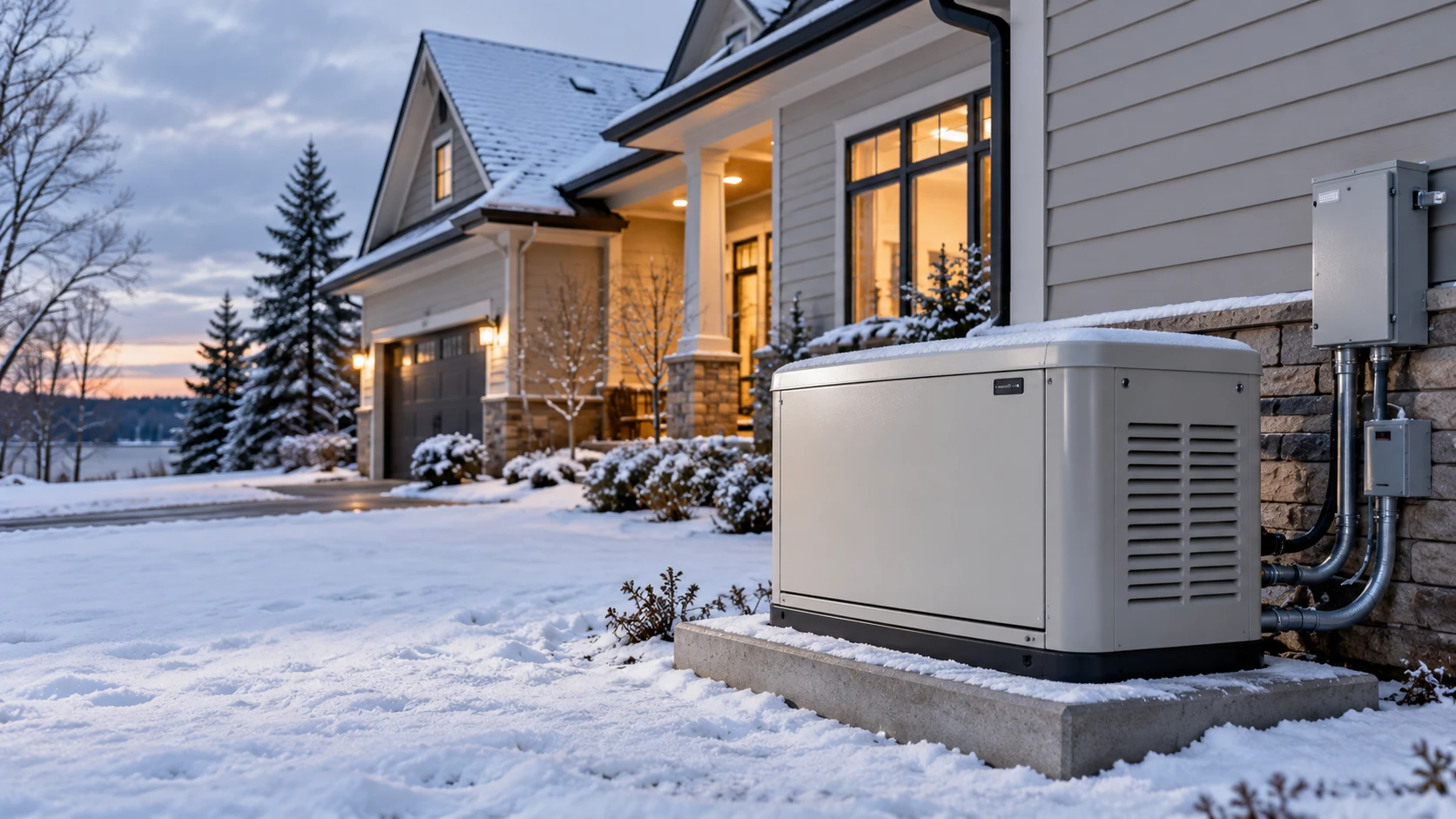
Cold changes the generator and the trench. Cummins rates its RS13A to RS20A units to 0 degrees F out of the box, and extreme cold versions to minus 40 degrees F, per its spec sheet. Ask which version fits a Barron County winter.
Frost reaches deep in northwest Wisconsin. The state building code sets footings at least 48 inches below adjacent grade. That rule covers building footings, and your installer follows the manufacturer’s pad and pipe-depth specs. Trenching for the gas and electrical runs is part of the job, and our digging and trenching crew handles it.
What about rural, farm and lake properties?
Many rural and lake properties have no gas main. Those homes run propane instead.
Large loads need a larger unit and a bigger gas plan. See our agricultural electrical services for farms and campground and recreation electrical work for seasonal properties with guest loads. Businesses that cannot afford downtime should also read how to prevent downtime from power failures.
What electrical code applies?
Wisconsin is adopting the 2023 National Electrical Code (NEC), replacing the 2017 edition with amendments. The Department of Safety and Professional Services (DSPS) says the new electrical code updates take effect September 1. Its safety updates include whole-home surge protection, limits on feeders per building and permits for services on vacant land.
NEC Article 702 covers optional standby systems like home generators. It requires a transfer switch whenever a standby generator connects to a building’s wiring, per EC&M’s code explanation. That article describes an older edition, and the transfer switch requirement carries forward. A generator that feeds the house without one is a code violation and a danger to utility crews.
Surge protection pairs well with a generator. See whole-house surge protection and our post on a generator causing power surges.
Who runs the gas piping?
Fuel gas piping is regulated work, and the license that applies depends on the job. Your installer should name the licensed professional who runs it and who holds the permit. DSPS Division of Industry Services answers licensing questions at 608-266-2112.
Planning a natural gas standby generator?
Meyers Electric handles load analysis, permitting, installation and service for Cummins standby systems. See our generator installation services or contact us in Rice Lake. Call (715) 234-3901, Monday to Friday, 7:00 AM to 4:30 PM CST.
Why bring in a licensed electrician before you call the gas utility?
The generator’s size and location set the gas load, and the gas load sets the meter question. An electrician sizes the generator and transfer switch, picks a code-compliant location, and gives the utility and the gas piper the numbers. That order avoids a second site visit.
The order that works looks like this.
- Call a licensed electrician for a load analysis.
- Pick the generator model and pad location.
- Send the model, BTU rating and location to the gas utility.
- Get permits and book the gas piping.
- Install, inspect and commission.
Generator work touches your panel, your gas supply and a permit. Never connect a generator to house wiring yourself. Never size or run gas pipe without a license. If you smell gas, leave the building and call your gas utility’s emergency line from outside. If you see sparks or smell burning at the panel, treat it as an electrical emergency. For everyday habits, see our electrical safety tips.
What mistakes should you avoid when planning a natural gas generator?
Most failed installs come from planning in the wrong order. Avoid these.
- Buying the generator before talking to the gas utility. The model sets the load, and the load sets the meter.
- Sizing from the half-load number. Size the gas supply for full load.
- Ignoring other gas appliances. The furnace still runs during an outage.
- Pouring a pad before checking meter and setback clearances. A pad that sits too close gets moved.
- Skipping permits. An unpermitted install can cost you at inspection and at resale.
- Skipping service. An unexercised unit fails when you need it. See Meyers PowerGuard.
FAQs
Will the gas company charge for a meter upgrade?
Often. CenterPoint Energy charges a fee, and Ameren Illinois bills ahead of the final install. Ask your own provider for the amount in writing before you commit to the generator.
What happens if the meter is too small and I install the generator anyway?
The generator and your other gas appliances compete for the same supply. Pressure sags when both run, and the furnace or the generator can starve. Fix the supply first.
Can the generator go next to the gas meter?
Not against it. Avista requires three feet on all sides of its meter. Cummins says its RS13A to RS20A units meet NFPA 37 spacing of 18 inches from the building. Confirm your provider’s clearance and your town’s setback before you pour a pad.
Do I need a second gas regulator?
Sometimes. Your installer checks supply pressure against the generator’s inlet range. Ameren Illinois says the installer supplies a second regulator when one is required.
Is natural gas or propane better for a lake home outside town?
Natural gas wins only if a main reaches the property. Without one, propane from a tank is the practical choice. Propane trades a fuel check for independence from the utility.
How do I know if my Rice Lake address has natural gas service?
Look for a gas meter on the building, or call the utility named on your bill. A property with only propane or fuel oil has no main to upgrade. Rural addresses outside town limits are the likeliest to lack a main.
Do I need a permit to install a natural gas generator in Wisconsin?
Yes in most cases. The electrical work and the gas piping both normally need permits and inspections, and your installer pulls them. Ask your municipality or county for its own process.
Does a bigger generator always need a bigger meter?
Not always, but gas demand rises with kW. A small unit on a light home may fit the existing meter, and a 20 kW or larger unit usually does not. The utility decides from the generator’s BTU rating.
Can a gas generator keep running if the gas utility has an outage?
No. The engine needs gas pressure. A widespread gas outage stops the generator, which is rare but is the one risk that a propane tank avoids.