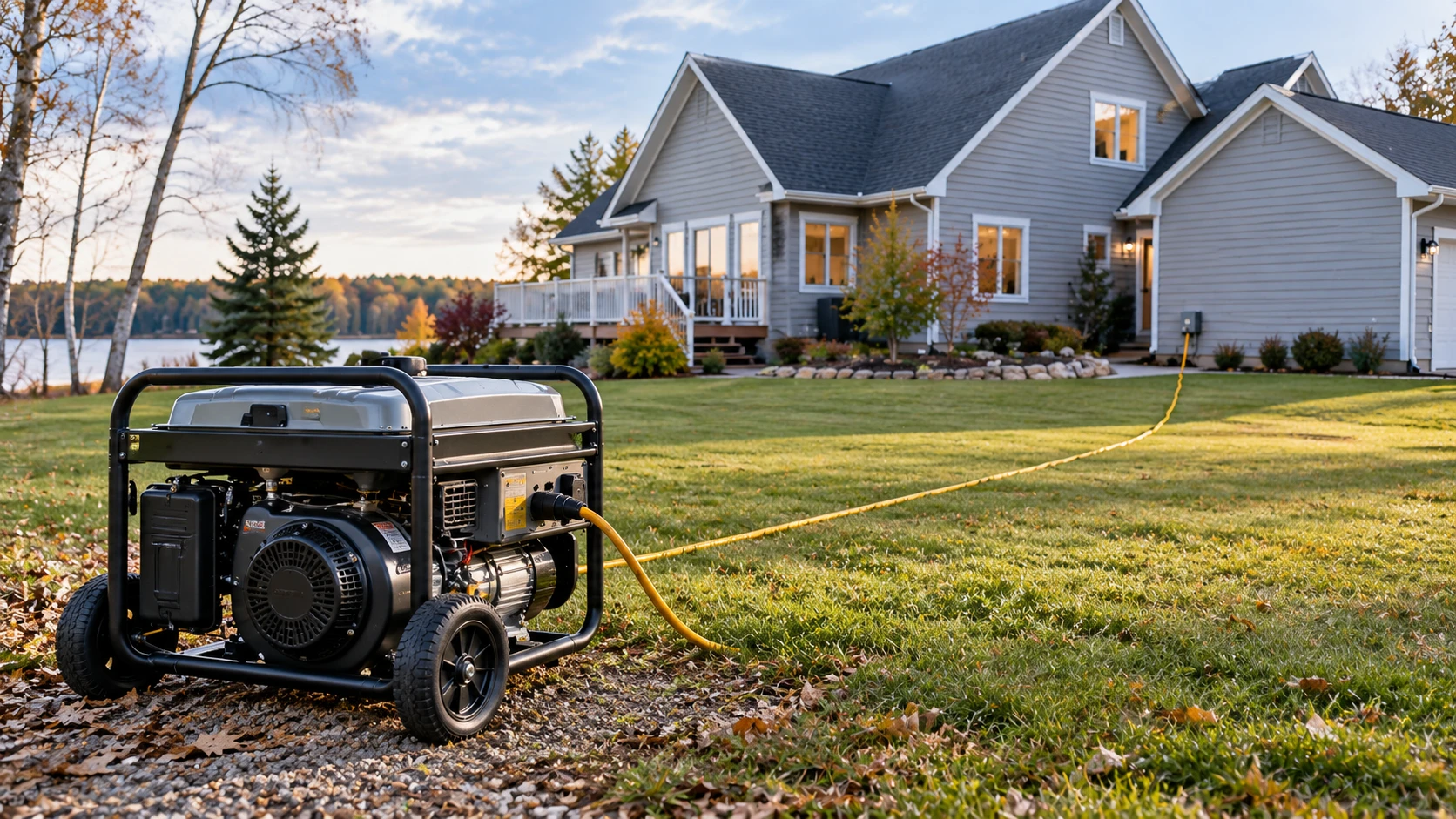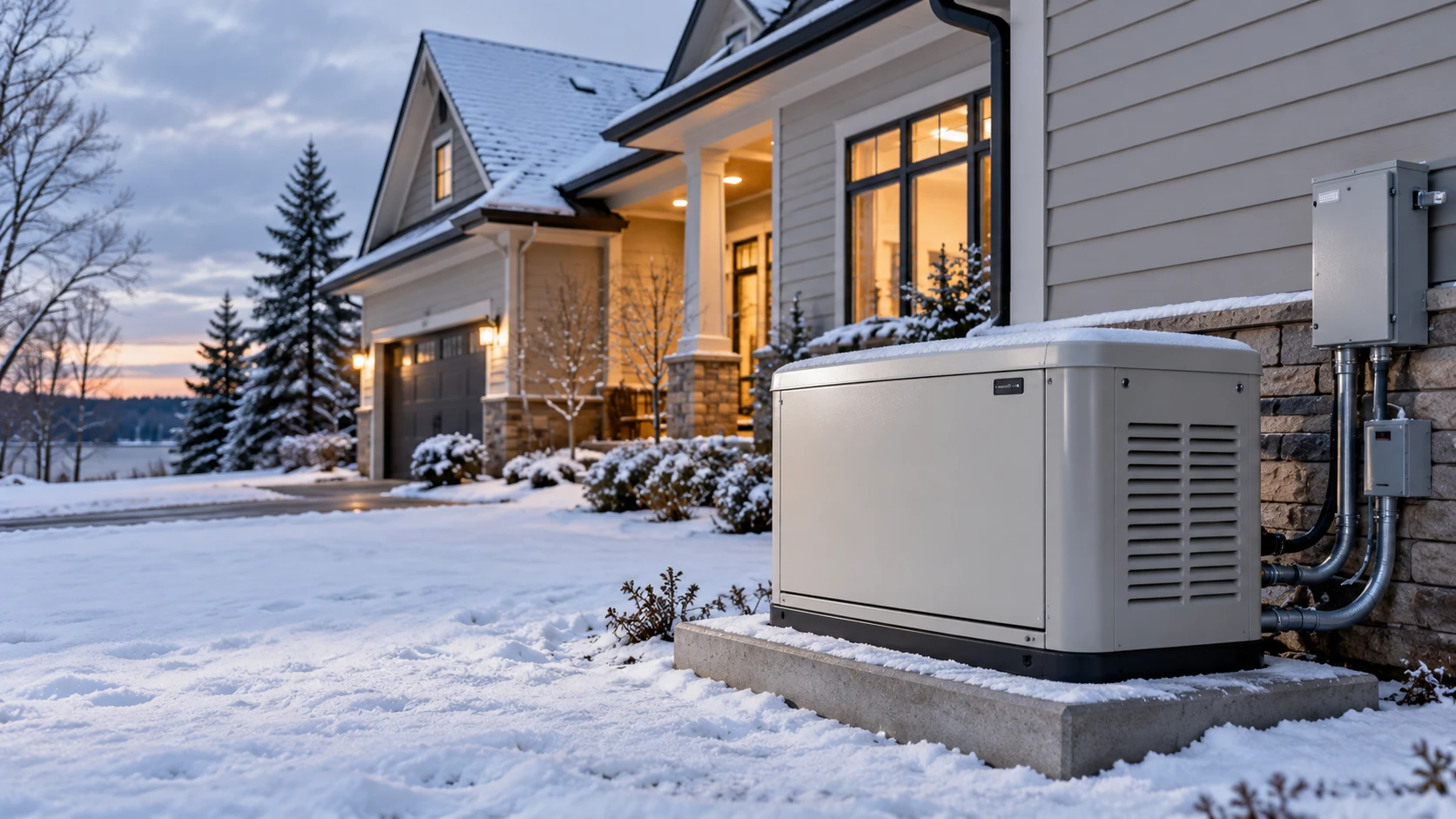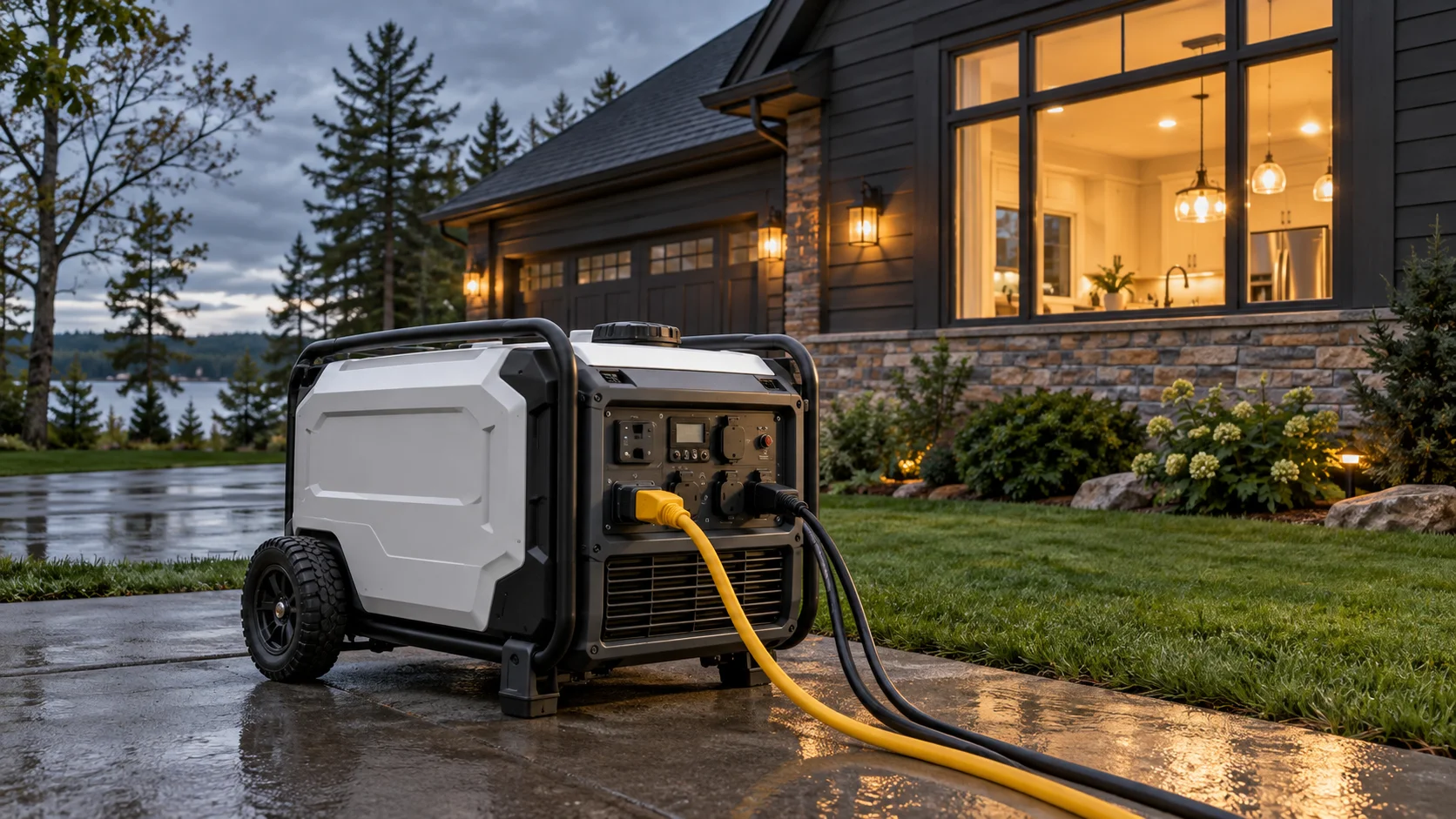

How far should a generator be from the house? A portable generator belongs at least 20 feet from the home, with the exhaust aimed away from the building. A permanently installed standby generator belongs at least 5 feet from windows, doors and other openings, and at the distance your model’s manual allows from the wall.
Meyers Electric sets generator locations for homes, farms and cabins across Rice Lake and northwest Wisconsin, and these are the numbers we work from.
Table of Contents
How far should a portable generator be from the house?
A portable generator should run at least 20 feet from the house. Point the exhaust away from the building, and keep it clear of every door, window and vent. The U.S. Consumer Product Safety Commission (CPSC) sets that 20-foot distance because exhaust carries carbon monoxide (CO), a gas with no smell or color.
The CPSC links portable generators to an estimated 765 non-fire carbon monoxide deaths from 2009 through 2019. Some manuals allow a closer placement, such as 5 feet from a window. The CPSC advises going to 20 feet regardless of what a manual says. Use the longer distance.
Why does 20 feet matter?
CO drifts. Wind, cold air and open windows pull exhaust toward a house. Twenty feet gives it room to thin out before it reaches an opening. Distance is one layer of protection. A battery-powered CO alarm on every level of the home is the other.
Can you run a generator in a garage, shed or under a deck?
No. Never run a generator in a garage, shed, basement or crawl space, even with the door open. Never run one on a porch or under a deck either. CO builds up inside enclosed and semi-enclosed spaces faster than an open door clears it.
How close can a standby generator be to a house?
A standby generator can sit as close as 5 feet to a wall, or 18 inches when the model is tested and listed for close placement. It must stay at least 5 feet from windows, doors, air intakes and other wall openings in every case. Those limits come from NFPA 37, the fire protection standard for stationary engines.
A standby generator is a permanent unit on a pad that starts on its own when the grid fails. The rules are different from a portable unit because the engine sits in a weatherproof enclosure and the installer controls the exhaust path.
What does NFPA 37 require?
NFPA 37 requires an outdoor stationary generator enclosure to sit at least 5 feet from openings in the walls of a building. It also requires at least 5 feet from walls made of combustible material, such as wood siding. A reduced distance applies only when the unit passes fire testing for close placement. That reduction applies to the wall surface. It never reduces the distance to a window or door.
Cummins markets its QuietConnect line as meeting NFPA 37 for installation as close as 18 inches from the home. That figure applies to the back of the enclosure and to listed models. A model without the listing uses the full 5 feet.
What clearances apply around the rest of the unit?
Leave working room on the other sides. Manufacturers and installers commonly call for about 36 inches at the front and ends, and several feet of open space above the unit. The exact numbers differ by model, so the installation manual decides. Never install a standby generator under a wooden deck or platform.
| Clearance point | Typical rule | Where it comes from |
|---|---|---|
| Windows, doors, vents, air intakes | 5 feet minimum | NFPA 37 |
| Combustible wall (back of unit) | 5 feet, or 18 inches for listed models | NFPA 37 and model listing |
| Front and ends | About 36 inches | Manufacturer installation manual |
| Overhead | Several feet, set by the manual | Manufacturer installation manual |
| Under a deck or porch | Not allowed | Manufacturer and local code |
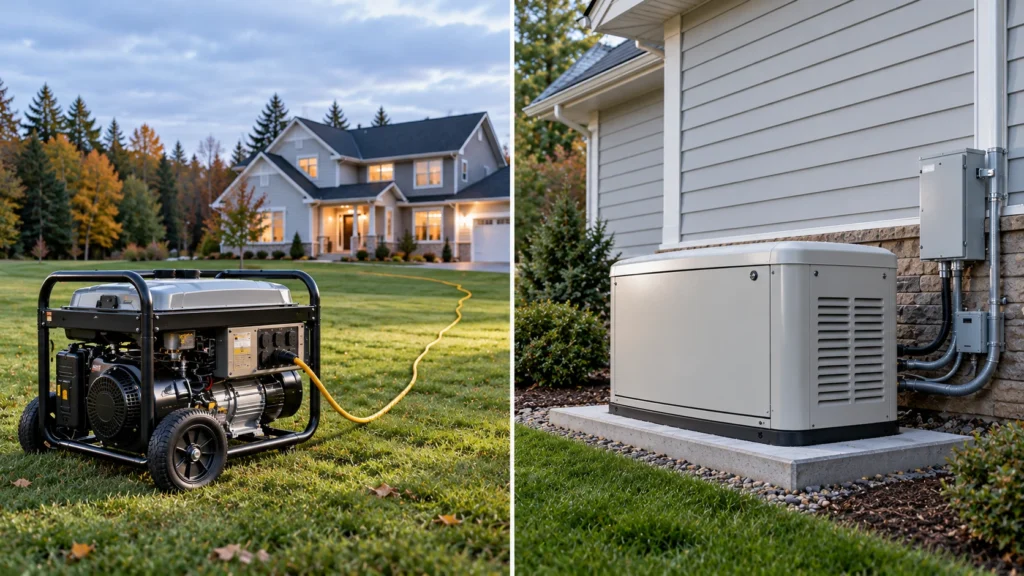
Portable vs standby: how far from the house?
Portable generators need more distance because you place them yourself, move them and run them on gasoline or propane in open air. Standby generators are fixed, enclosed and installed to code. Different rules apply to each, so the answer to how close a generator can be to a house depends on the type.
| Portable generator | Standby generator | |
|---|---|---|
| Distance from house | At least 20 feet | 5 feet from openings, 18 inches to 5 feet from a wall (per model) |
| Exhaust direction | Away from the home and neighbors | Set by the installer |
| Who sets the spot | You | A licensed electrician and gas installer |
| Permit | Not for a plug-in setup. Yes for an inlet box or transfer switch | Electrical and fuel permits |
| Typical fuel | Gasoline or dual fuel | Natural gas or propane |
Where is the best place to put a generator outside?
Put the generator on firm, level ground away from openings, with open air on all sides and a short, safe run to your panel or gas line. For a portable unit, pick a spot downwind and 20 feet from the house. For a standby unit, pick a spot near the meter and panel that still meets every clearance.
Follow this order when you choose a spot:
- Mark every window, door, vent and air intake on the nearest walls, including basement window wells.
- Measure out the required distance from each: 20 feet for portable, 5 feet for standby.
- Check that no deck, porch, eave or overhang sits above the spot.
- Pick level, well-drained ground. For a standby unit, plan on a pad.
- Keep snow, leaves and brush clear of the intake and exhaust sides.
- Confirm the route for the fuel line and the electrical conduit.
- Have a licensed electrician approve the final location before the pad goes in.
Steps 6 and 7 are not DIY. A licensed electrician and a licensed gas installer handle the fuel and electrical connections.
Does a generator need a pad?
A standby generator sits on a level, stable base, usually a concrete or composite pad. The pad keeps the unit level and above runoff. In northwest Wisconsin, frost heave can shift a poorly prepared base over a few winters.
Can you hide a generator with landscaping?
Yes, but only outside the clearance zone. Plants and fences can screen a unit from view. They cannot block the air intake, the exhaust or the service space around the enclosure. Keep shrubs, vines and stored items out of the clearance zone, and trim growth each season.
Can a generator get wet?
Snow and rain are part of Wisconsin life. A standby unit is built for outdoor weather. A portable unit is not. Running one in the rain without proper cover is a shock and fire risk.
Do you need a permit to install a standby generator in Wisconsin?
Yes. A standby generator connected to your home needs an electrical permit in Wisconsin, and a fuel gas or mechanical permit when it runs on natural gas or propane. Your municipality may also require a building or zoning permit for the pad and setbacks. A licensed electrician pulls these permits.
Wisconsin regulates electrical work through the Department of Safety and Professional Services (DSPS) under Chapter SPS 316, which adopts the National Electrical Code (NEC) with state changes. DSPS says the state is adopting the 2023 NEC, effective September 1, 2026. Generator hookups to a home fall under the optional standby systems rules in NEC Article 702.
Some Wisconsin cities also ask for a site plan that shows the generator, the house and the distance between them. For example, New Berlin requires a drawing of the generator location and a zoning setback check with the permit.
Does a portable generator need a permit?
A portable generator you plug into with cords needs no permit. An inlet box, interlock kit or transfer switch wired to your panel does. That work belongs to a licensed electrician. Never plug a generator into a wall outlet. That backfeeds the lines and can injure a utility worker.
What about propane tanks and gas regulators?
Fuel adds its own distances. NFPA 37 and NFPA 54 require the gas regulator vent to sit at least 5 feet from building openings and ignition sources. Some local codes set a minimum distance from the generator to a propane tank fill valve. A licensed installer sets these on every job.
How do you protect a generator from theft?
Place the generator in view of the house, secure it to its pad and keep it locked, with outdoor lighting nearby. A standby unit is bolted to its pad and wired to the home, which makes it a harder target. Portable units are the usual theft risk, so lock them to a fixed point when they are not in use.
Do not store fuel or run a portable unit inside a locked garage to protect it. That trades one risk for a worse one.
What does Wisconsin add to generator placement?
Wisconsin adds snow, frost and rural property layouts. Winter storms drift snow against walls and bury intakes. Frost can heave a pad. Farms and lake properties often have several buildings, long runs to the panel and extra setback rules.
- Snow: Keep snow cleared from the intake, exhaust and service sides of a standby unit. Keep the exhaust of a portable unit clear of drifts.
- Eaves and overhangs: Roof edges can dump snow and ice on a unit. Leave the overhead clearance in the manual.
- Frost and trenching: Underground fuel and electric lines run below frost depth. See our digging and trenching services.
- Farms and barns: Place a generator for a barn with its own load list. See our agricultural electrical services.
- Cabins and campgrounds: Rules also apply to lake cabins and RV pads. Our camper and RV generator guide covers that setup.
Want a generator placed the right way the first time?
Meyers Electric picks the location, pours the pad, runs the fuel and electrical lines and handles the permits. See our generator installation services or contact us in Rice Lake.
Why should a licensed electrician set the location?
A generator location touches your panel, your fuel supply, your permits and your safety. A licensed electrician measures every clearance, checks the manual and code, and files the permit. A wrong guess can fail inspection, void a warranty or put exhaust where it should not go.
Meyers Electric covers load analysis, permitting, installation and maintenance for generators across northwest Wisconsin. After the install, the Meyers PowerGuard plan covers annual inspection and testing. If your panel is already crowded, read our post on an overloaded electrical panel first.
FAQs
How far should a generator be from the house in winter?
The same as any other season: 20 feet for a portable unit and the model’s listed clearance for standby. Winter adds one more job. Keep the intake and exhaust clear of snow. Never move a portable unit into a garage to keep it out of the cold while it runs.
How close can a Generac or Cummins generator be to a house?
Models tested and listed for close placement can sit 18 inches from a wall. Every model must still sit at least 5 feet from windows, doors and other openings. Unlisted models need 5 feet from combustible walls. Your installation manual and local code decide the final number.
Can a generator sit directly against the house?
No. Even a unit listed for close placement needs space. Leave the manual’s clearance at the back, front, ends and top. Zero clearance blocks airflow, traps heat and risks fire. Standby units are installed with a measured gap.
Does a portable generator need to be 20 feet from the house if I only run it for a few minutes?
Yes. CO can reach dangerous levels quickly, and a short run is not safe if the exhaust reaches an opening. Use the 20 feet every time, and keep working CO alarms in the home.
How far from my lake or cabin property line can a generator sit?
Setbacks vary by town and county. A permit for a standby generator may ask for a site plan that shows distances to the lot line. Ask your municipality before the pad goes in.
Do I need a permit to move my existing generator to a new spot?
Often yes for a standby unit. Moving it means new fuel and electrical runs. Ask your electrician and your municipality before moving it. A portable unit you only plug into needs no permit.
Does Meyers Electric install generators near Rice Lake?
Yes. Meyers Electric installs standby generators for homes, farms, businesses and pblic facilities across Rice Lake and northwest Wisconsin. Call or use our contact page to book a site visit.