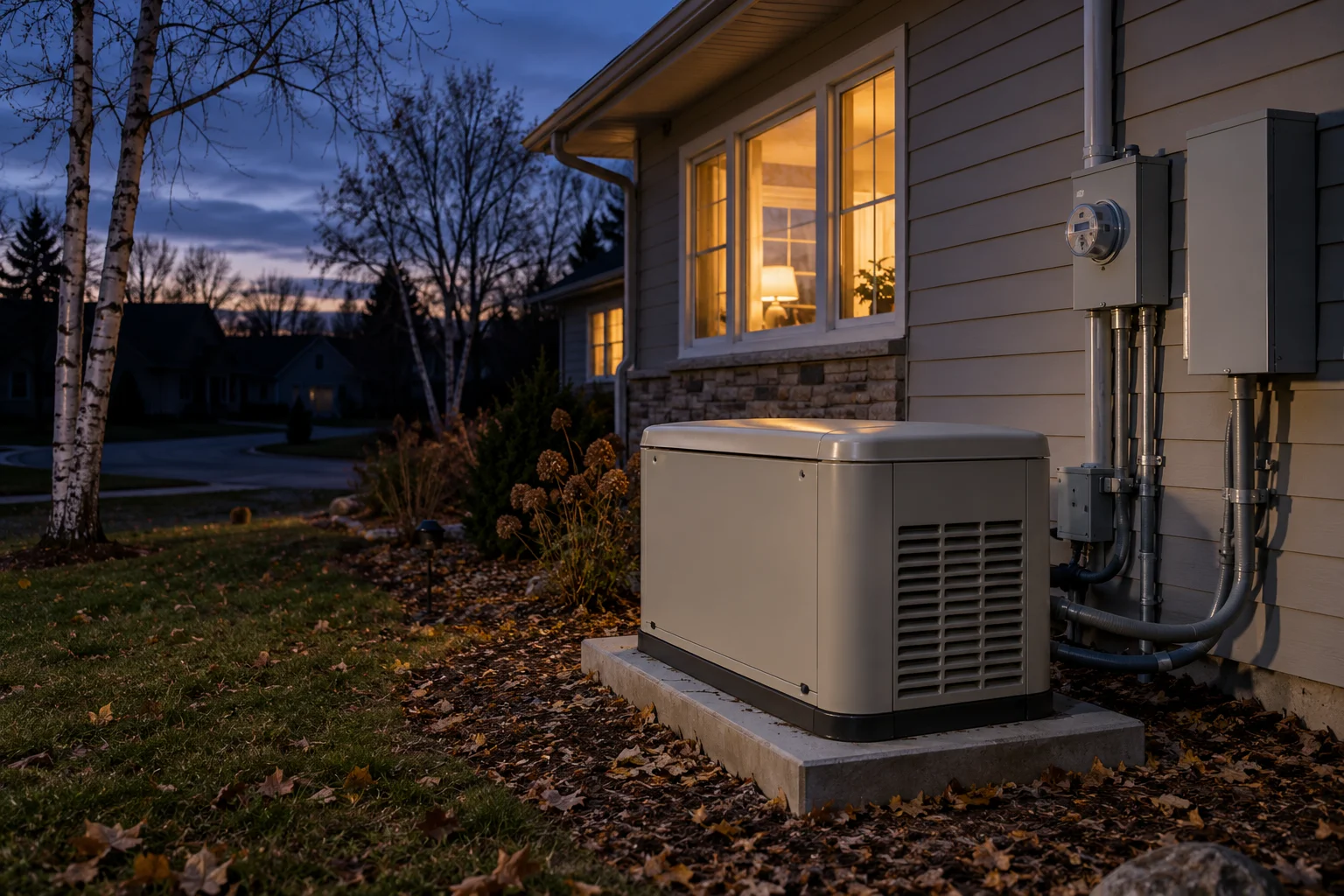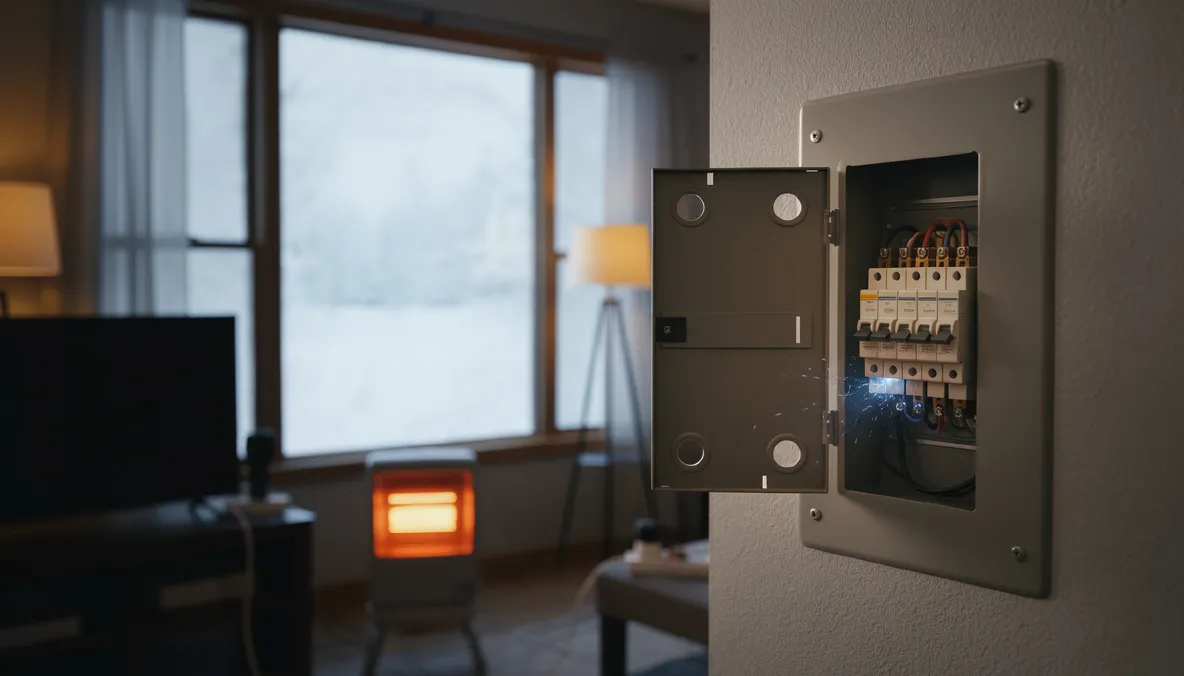

What size generator do I need? Add the running watts of everything you want to power, add the largest starting surge, and divide by 0.9. For a Rice Lake home, that usually lands between 3,000 watts for essentials and 18,000 watts or more for the whole house. Meyers Electric sizes generators for homes, farms and cabins across northwest Wisconsin, and the math below is the same math we start with.
Table of Contents
How do you calculate the generator size you need?
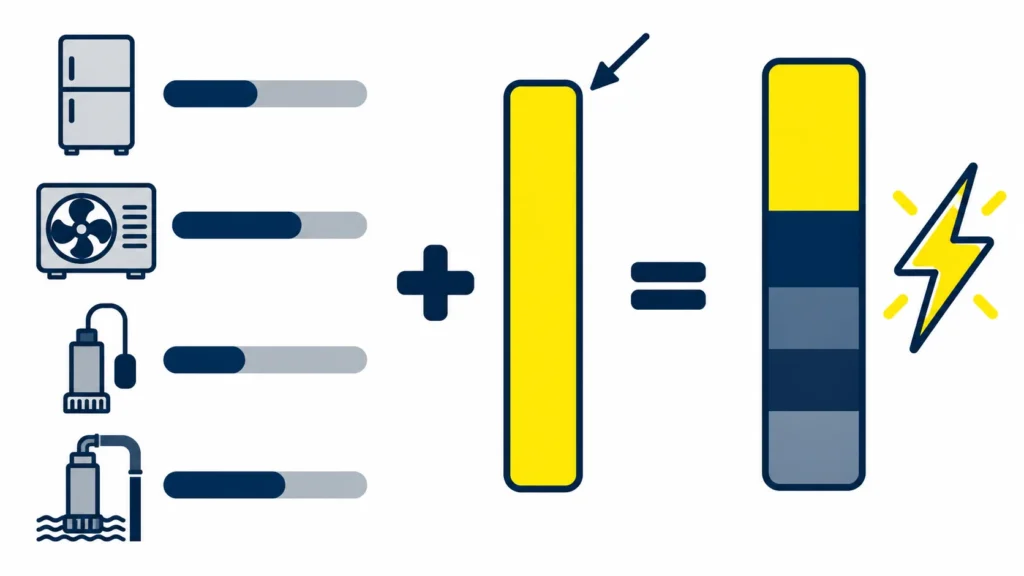
Add the running watts of every item you want on during an outage. Add the single largest starting surge on top. Divide by 0.9. That final number is the smallest generator you should buy. This sizing guide uses the same formula and keeps load at or below about 90% of capacity.
Here is the process in order:
- List what must stay on. Think refrigerator, furnace, sump pump, well pump, lights, and a phone charger.
- Find the running watts for each item. Look at the nameplate on the appliance.
- Add the running watts together.
- Find the starting watts for motor-driven items. Motors need a short surge to start.
- Add only the largest surge to your running total.
- Divide by 0.9 and round up to the next generator size.
Running watts are the power an appliance uses once it is going. Starting watts are the brief extra power a motor pulls to get going. A refrigerator, sump pump or furnace blower each has both numbers.
A worked example
A homeowner wants a refrigerator, a sump pump and a TV during an outage.
- Refrigerator: 700 running watts, 2,200 starting watts
- Sump pump: 800 running watts
- TV: 350 running watts (top of the 100 to 350 range)
- Running total: 700 + 800 + 350 = 1,850 watts
- Largest surge above running: 2,200 – 700 = 1,500 watts
- Total: 1,850 + 1,500 = 3,350 watts
- Divide by 0.9: about 3,720 watts
That homeowner needs a generator rated at 4,000 watts or higher. Add a furnace blower and a well pump, and the number climbs fast.
How many watts do common appliances use?
Appliance wattage varies by model, so the nameplate always beats a chart. Use published ranges only as a starting point.
| Appliance | Running watts | Starting watts |
|---|---|---|
| Refrigerator / freezer | 600 to 800 | 2,200 |
| Sump pump | 800 to 1,500 | 1,300 (one model listed) |
| Washing machine | 750 to 1,150 | 2,250 (one model listed) |
| TV | 100 to 350 | None listed |
| Microwave | 625 to 1,200 | None listed |
| Space heater | 1,250 to 1,800 | None listed |
| Central AC | 2,000 to 4,000 | Check nameplate |
| Water heater (electric) | 3,000 to 4,500 | None listed |
| Clothes dryer (electric) | 1,500 to 5,000 | None listed |
| Electric oven | 5,000 | None listed |
| Electric furnace | 5,000 to 25,000 | Check nameplate |
Two items need extra care in Wisconsin. A well pump and a gas furnace blower both start on a motor surge, and their sizes vary widely. Read the nameplate or ask an electrician to measure them.
What size generator do I need for my house?
Most homes need a 7,500-watt to 18,000-watt generator for broad coverage. Smaller units cover essentials only. The right size depends on whether you want critical circuits or the whole house, and on big loads like central air, an electric water heater and an electric dryer.
| Generator size | What it typically covers |
|---|---|
| 7,500 W (7.5 kW) | 2-ton AC, kitchen, furnace, sump pump, living areas. No water heater, office or garage |
| 10,000 W (10 kW) | 3-ton AC, adds a water heater. No office or garage |
| 18,000 W (18 kW) | 5-ton AC, 3 bathrooms, 5 bedrooms, adds office and garage |
| 25,000 W (25 kW) | Same as 18 kW with more headroom |
Critical circuits or the whole house?
A critical-circuits setup powers a short list of essentials. A whole-house setup powers nearly everything at once. Critical circuits cost less and run on a smaller unit. Whole-house gives you normal life during a long storm outage.
Square footage alone does not set the size. Two 2,000-square-foot homes can differ by 10,000 watts if one has electric heat and the other runs on propane.
Does a 200 amp panel decide the generator size?
No. Your service size (the main panel rating) sets the maximum the utility can feed you. The generator is sized to the loads you choose to back up. A load calculation done by a licensed electrician ties the two together. If your panel is already crowded, read our guide on an overloaded electrical panel first.
Should you choose a portable or standby generator?
Portable generators suit one or two essentials. Standby generators suit homes that want automatic, whole-house or critical-circuit power. A standby unit is wired to your panel through a transfer switch and starts on its own when the utility power fails.
- Portable (about 2,000 to 10,000 watts): You roll it out, fuel it and connect the loads. It must run outdoors.
- Inverter portable: Quieter and cleaner power for electronics. Smaller output.
- Standby (about 7.5 to 25 kW): Always installed, runs on natural gas or propane, and switches on automatically. We cover how that works in our post on a generator that starts automatically.
Never plug a portable generator into a wall outlet or run it inside a home. That backfeeds the lines and can injure a utility worker. Safe connection takes a transfer switch installed by a licensed electrician.
What size generator do I need to run a refrigerator?
A refrigerator needs a generator with at least 2,200 starting watts. A 3,000-watt portable covers it with room for lights. Add other loads, and use the formula above.
The surge is the catch. A fridge may only use 700 running watts, but the compressor needs about three times that for a second when it kicks on. A generator sized only on running watts will stall.
What size generator do I need for a camper or RV?
A camper’s hookup sets the ceiling, and your actual loads set the size. A 30-amp camper connection tops out near 3,600 watts (30 amps x 120 volts). A 50-amp connection tops out near 12,000 watts (50 amps x 240 volts). Most campers never use all of it.
Add up the air conditioner, microwave, water heater and electronics you plan to run together. If the AC is on, plan for its starting surge. Campgrounds that offer power should be wired and sized by a licensed electrician too. See our campground and recreation electrical work.
What does Wisconsin add to the sizing math?
Wisconsin adds cold, distance and rural loads. Winter outages in Barron County put the furnace blower, well pump and sump pump on the same generator at the same time. Farms and lake properties add large motors, barn fans, and sometimes more than one building.
- Winter heating: Gas and propane furnaces still need a blower motor. Electric heat can add 5,000 watts or more.
- Well pumps: Rural homes without city water lose water the moment the power fails.
- Sump pumps: Spring thaw and heavy rain make this a critical load.
- Farm and cabin loads: Barn motors, milking or ventilation equipment, and lake-property pumps need their own load list. See our agricultural electrical services.
- Code: Wisconsin adopts the National Electrical Code (NEC) through SPS 316. The Department of Safety and Professional Services says the 2023 NEC takes effect September 1. NEC Article 702 covers optional standby systems like home generators.
- Utilities: Your outage history depends on whether you are served by Xcel Energy, Barron Electric Cooperative, or Rice Lake Utilities.
Why should a licensed electrician confirm the size?
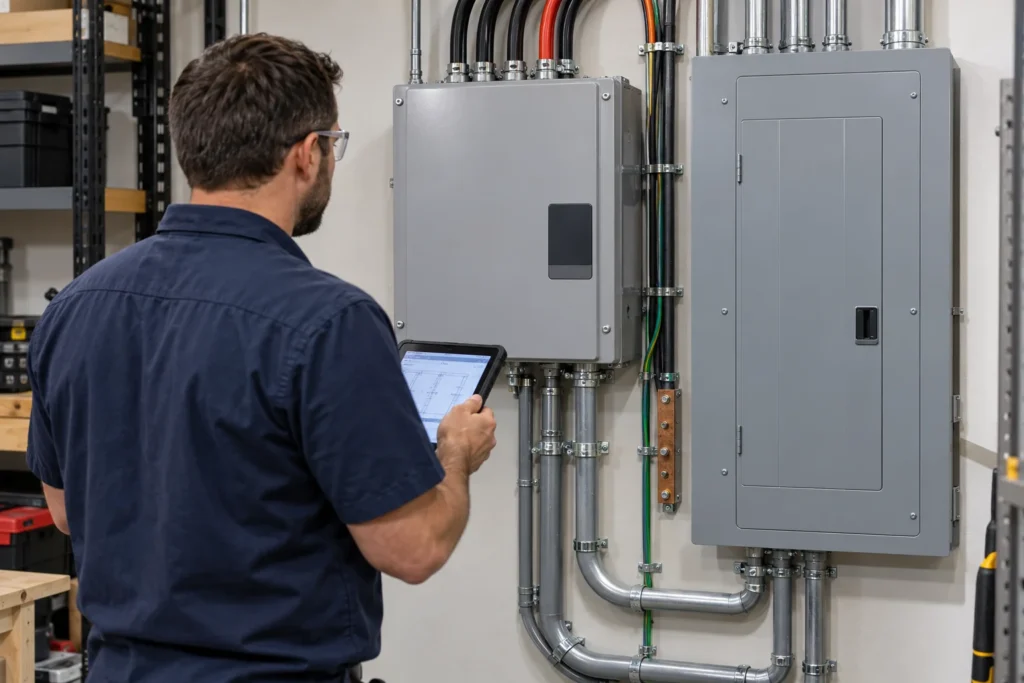
Because generator work involves your panel, fuel lines, and permits. An electrician measures real loads, sizes the transfer switch, and files the permit and inspection. A guess can leave you with a unit that trips under load or a setup that is not code compliant.
Safety is part of sizing too. The U.S. Consumer Product Safety Commission links portable generators to an estimated 765 non-fire carbon monoxide deaths from 2009 through 2019. It says to keep them at least 20 feet from the home, with exhaust pointed away.
Meyers Electric measures your loads, picks the right unit, and handles permits and installation. See our generator installation services or contact us in Rice Lake.
Frequently Asked Questions
Can I use a generator size chart instead of adding up my loads?
A chart gives a fast estimate, not a final answer. Two homes with the same square footage can need very different sizes. Use the chart to pick a range, then confirm with a load calculation.
Does a bigger generator waste fuel?
A bigger unit does not burn more fuel by itself. It burns more as the load rises. An oversized standby unit costs more upfront, though, and a very light load on a big engine is less efficient. Aim for a size you can run between roughly half and 90% of capacity.
Do I need a permit to install a generator in Wisconsin?
A standby generator hooked to your panel needs electrical work done to code, and that normally means a permit and inspection. Your electrician pulls it. Confirm local requirements with your municipality or county.
Can an inverter generator run my whole house?
Usually not. Inverter units are quiet and clean, but most have smaller outputs aimed at electronics, camping and a few essentials. Whole-house loads call for a standby unit or a large conventional portable with a transfer switch.
Will adding an EV charger or heat pump change my generator size?
Yes. A Level 2 EV charger or a heat pump adds a large, steady load. Tell your electrician before sizing so those circuits are counted or intentionally left off the backed-up list. See our post on EV charging station cost.
What if my generator is too small and trips or surges?
An undersized generator can overload, shut off, or deliver unstable power. A mismatched setup can also stress sensitive electronics. Read our post on a generator causing power surges, and think about whole-house surge protection.
How do I size a generator for a power outage in northern Wisconsin winters?
Count the furnace blower and any electric heat first, then add well and sump pumps. If you run a wood or propane backup, list only the electrical parts. A short winter list often fits a smaller unit than a full-house list.