
What size generator to run a refrigerator and freezer? A 2,000 to 2,500 watt generator handles one full-size refrigerator. Add a furnace, a sump pump or a second freezer and you need 5,000 watts or more. Meyers Electric helps homeowners and farms across Rice Lake and northwest Wisconsin keep the essentials running when a storm takes the power out.
Table of Contents
What size generator do you need to run a refrigerator?
A full-size refrigerator draws roughly 600 to 800 watts while running. A 2,000 to 2,500 watt generator covers that and the compressor’s startup surge. Check your fridge’s nameplate for exact numbers, because models vary.
The surge is what trips small units. A compressor needs extra power for a moment each time it starts.
How many watts does a refrigerator use?
Running watts are what the fridge draws all day. Starting watts are the short spike when the compressor kicks on. Michigan State University Extension lists a refrigerator or freezer at 600 to 3,000 watts, and notes that electric motors usually need three to four times more wattage to start than to run (MSU Extension).
That MSU table is from 1998, so older and larger units sit at the top of its range. Newer models usually run lower. Read the label on yours.
Will a 2,000 or 2,500 watt generator run a refrigerator?
Yes, for one standard refrigerator. A 2,000 watt unit has little headroom for a large or older fridge. A 2,500 watt unit gives a safer margin. Neither runs a refrigerator, a freezer and a furnace together.
Can a generator damage a refrigerator?
A generator that is too small can. An overloaded unit sags in voltage, and a compressor under low voltage can overheat. A generator with a clean, steady output is easier on electronics. Our post on a generator causing power surges explains what goes wrong.
What size generator do you need for a refrigerator and freezer together?
Plan on 3,000 to 3,500 watts for a refrigerator plus a chest or upright freezer. Add both running watts, then add the highest starting watts of the two. Start them one at a time so the surges do not stack.
Farm and lake-home owners in Barron County often keep a second freezer in the garage or barn. Count it. It is the load people forget.
Planning for your whole house instead? See our full generator sizing guide.
What size generator to run a furnace?
Most gas furnaces draw 400 to 2,000 watts, mostly for the blower fan and controls. MSU Extension lists gas furnaces at 400 to 2,000 watts and oil furnaces at 500 to 2,500 watts. A 3,000 watt generator runs a furnace alone. Add a refrigerator and a sump pump and you need more.
A furnace is almost always hard-wired. Do not plug it into a generator with an extension cord.
Can you run a furnace on a generator?
Yes, but not by plugging it in. MSU Extension says furnaces and water pumps are hard-wired and cannot be plugged into most portable generators. They need a transfer switch installed by a licensed electrician.
Call Meyers Electric for that job. It involves your panel, a permit and an inspection.
Can you run a gas furnace off a generator?
A gas furnace still needs electricity for the blower and controls. The generator powers those. The gas supplies the heat. The same rule applies: a licensed electrician connects it through a transfer switch.
Can you plug a space heater into a generator?
You can plug in a portable electric space heater, but it is a heavy load. Most draw about 1,500 watts. Check the label, and give it its own generator or its own turn on the load. Never run a generator indoors to power a heater.
What size generator to run a sump pump?
A 3,000 to 3,500 watt generator runs most home sump pumps alone, including the startup surge. Sump pump wattage varies widely by horsepower and model, so check your pump’s nameplate for its running and starting watts.
A sump pump matters most during spring thaw and heavy rain, when outages and flooding overlap.
What size generator for a sump pump and refrigerator?
Add the two running totals, then the higher of the two starting figures. For many homes that lands near 4,000 to 5,000 watts. Use the formula in the next section with your own nameplate numbers.
How do you size a generator for essentials only?
Add the running watts of everything you will run. Then add the highest starting watts among them. This formula as total running watts plus highest starting watts, and says to keep the load under 90 percent of the generator’s capacity.
Here is the method with example numbers. These are for illustration only, not product specs.
- Refrigerator: 700 W running
- Gas furnace blower: 600 W running
- Sump pump: 1,000 W running, about 3,000 to 4,000 W to start (three to four times, per MSU Extension)
- Total running: 2,300 W
- Add the highest starting watts: 2,300 + 3,000 to 4,000 = 5,300 to 6,300 W
- Divide by 0.9 to stay under 90%: about 5,900 to 7,000 W
That is a conservative result. Your nameplate numbers may be lower, which can lower the size.
Generator size for common essentials
| What you want to run | Typical starting point |
|---|---|
| One refrigerator | 2,000 to 2,500 W |
| Refrigerator and freezer | 3,000 to 3,500 W |
| Furnace blower alone | About 3,000 W |
| Sump pump alone | 3,000 to 3,500 W |
| Refrigerator, furnace and sump pump | 5,000 W or more |
These are planning ranges built from the published figures above. They are not a substitute for reading your nameplates.
What size generator to run an air conditioner?
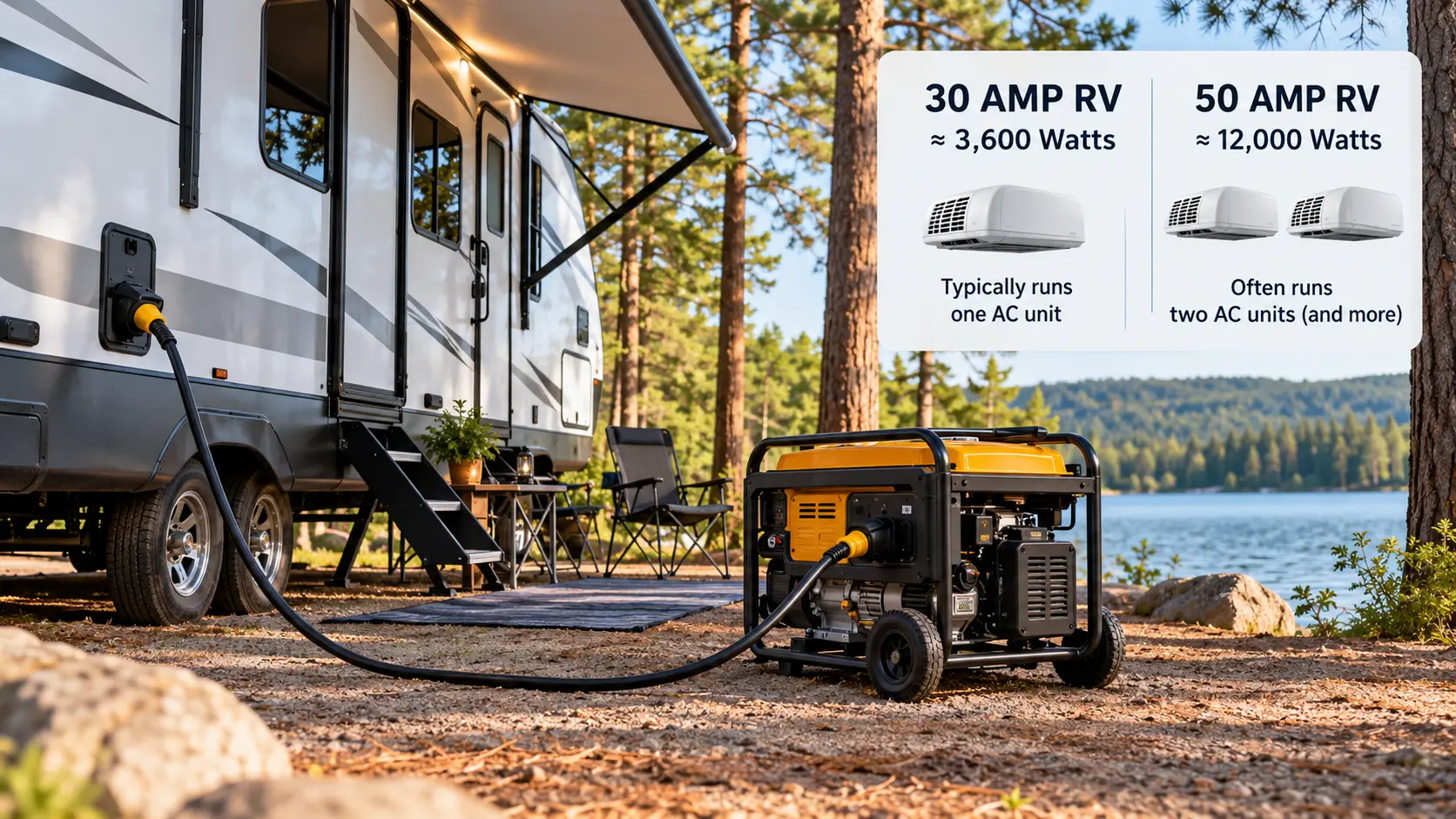
A central air conditioner is a much bigger load than a refrigerator, and its compressor surge is large. Most window units fit a mid-size portable generator. Central air usually needs a large portable or an installed standby unit.
A soft start device can lower the surge. MicroAir says its RV soft start cuts the starting surge by as much as 75% (MicroAir). Ask an electrician whether one suits your unit.
For a camper air conditioner, see our guide to sizing a generator for a camper or RV.
How do you connect a generator to a refrigerator, furnace or sump pump safely?
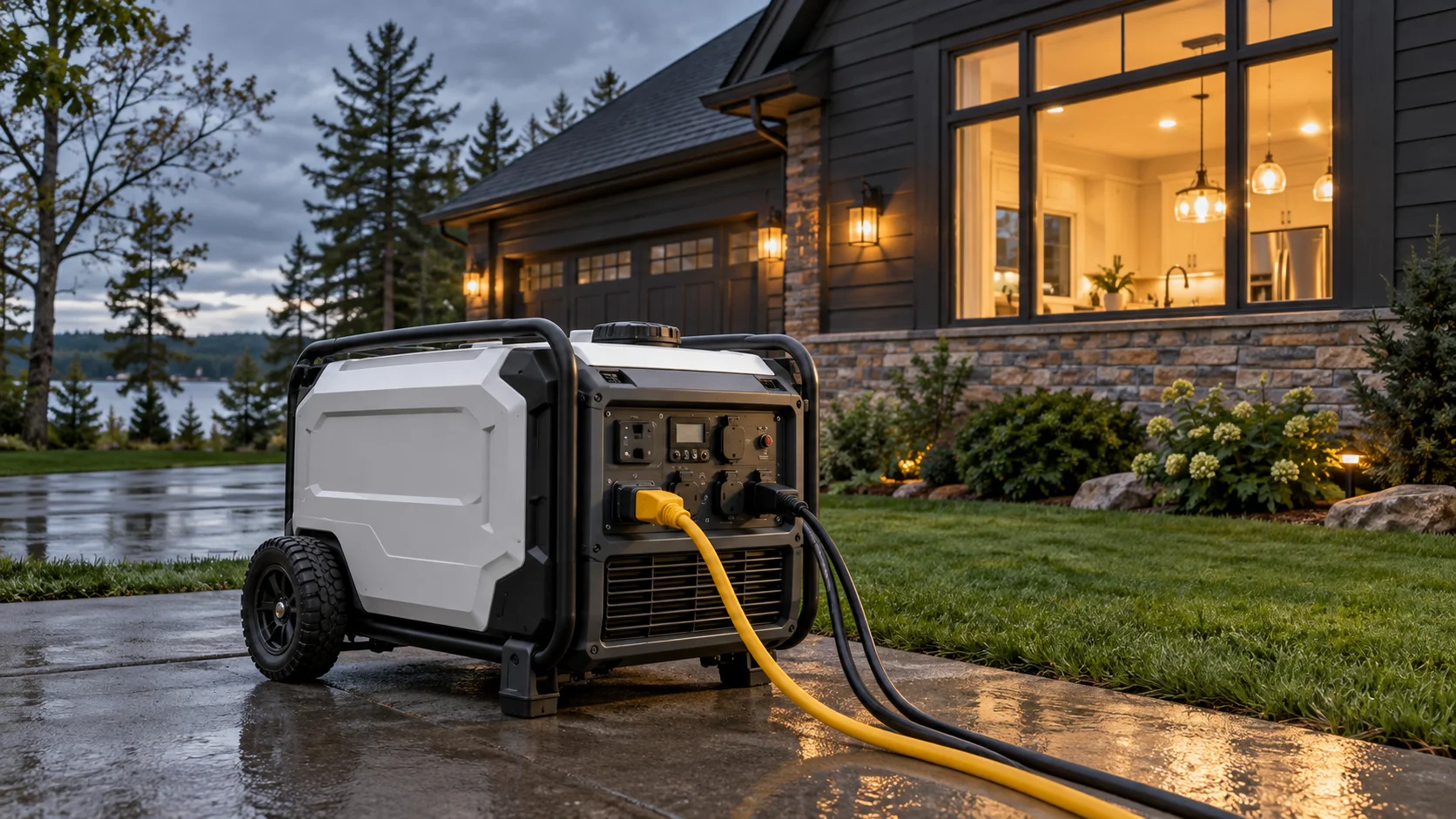
Plug a refrigerator or freezer directly into the generator with a heavy-duty extension cord. Connect a furnace, a hard-wired sump pump or a well pump only through a transfer switch installed by a licensed electrician. Never plug a generator into a wall outlet.
Backfeeding a house panel sends power back onto the utility lines. It can injure or kill a lineworker. It can also destroy the generator.
What extension cord do you need?
Use an outdoor-rated, heavy-duty cord rated for the load, as short as practical. MSU Extension warns that overloaded extension cords can overheat and cause fires.
Where should you put the generator?
Outdoors, well away from doors, windows and vents. The U.S. Consumer Product Safety Commission says never to run a generator in a garage, basement or other enclosed space. See its portable generator safety alert.
Put battery-powered carbon monoxide (CO) alarms on every level. CO is a gas with no smell.
What does a Wisconsin outage change about generator sizing?
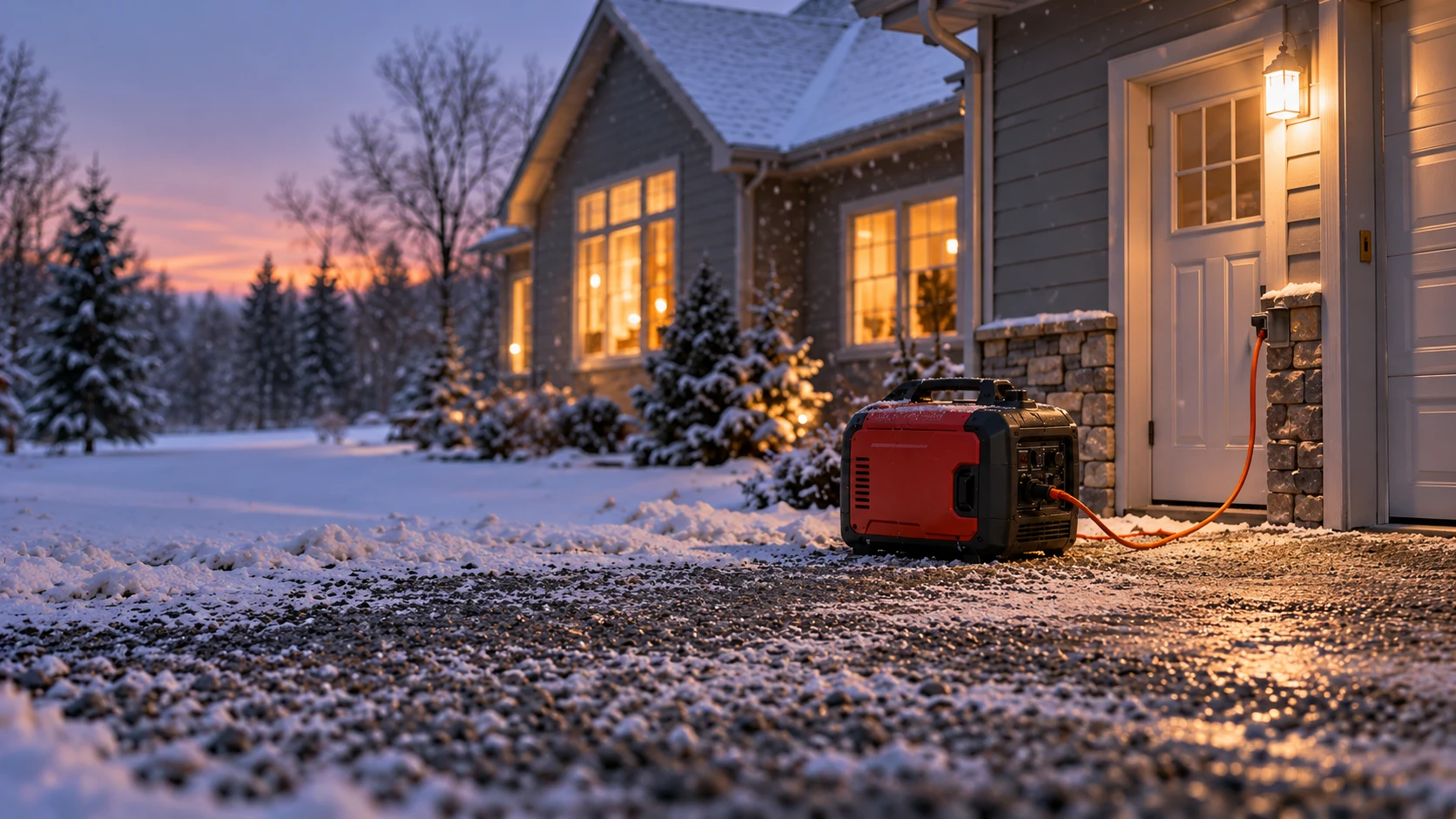
Wisconsin adds cold, long outages and rural loads. In January, a furnace is not optional. A farm or lake home may also run a second freezer, a well pump and a sump pump at once. Size for the winter case first.
- Winter outages: Prioritize the furnace blower and refrigerator, then add the sump pump for spring.
- Rural and farm loads: Well pumps and barn freezers add real watts. Count them.
- Fuel and run time: Plan fuel for a multi-day outage. [CLIENT TO CONFIRM crew guidance.]
- Permits: A transfer switch or standby install typically involves a permit and inspection. Wisconsin adopts the National Electrical Code (NEC) through SPS 316. [CLIENT TO CONFIRM current NEC edition in force. ICC lists the 2017 NEC, effective 2018 for commercial and 2020 for one- and two-family dwellings, but a newer edition may apply.]
Want furnace and sump pump power without extension cords?
Meyers Electric installs transfer switches and standby generators for homes, farms and small businesses across northwest Wisconsin. See our generator installation services or contact us in Rice Lake.
When should you call a licensed electrician?
Call one for any hard-wired load: a furnace, a well pump, a sump pump wired to the panel, or a transfer switch. These jobs involve your panel, a permit and an inspection. Plugging a refrigerator into a portable generator is not that kind of work. Wiring a generator into your house is.
If your panel is already crowded, read our guide on an overloaded electrical panel first.
FAQs
Is a generator AC or DC?
A portable home generator produces AC (alternating current), the same type of power as your wall outlets. That is why you can plug a refrigerator straight into it. Some small battery power stations convert DC to AC internally, but the output you plug into is AC.
Will a 3,500 watt generator run two refrigerators?
Usually yes for two standard refrigerators, if you start them one at a time. Two full-size units at 600 to 800 watts each use 1,200 to 1,600 watts running. The startup surge is the limit, so check both nameplates.
Will a 5,000 watt generator run a well pump?
Often yes for a typical residential well pump. MSU Extension lists water pumps at 1,000 to 3,500 watts. Because a well pump is hard-wired, it needs a transfer switch. A licensed electrician makes that connection.
How long can a generator run a refrigerator?
It depends on fuel and the generator’s load. A fridge cycles on and off, so it uses less fuel than a constant load. Check your generator’s rated run time at the load you plan to carry.
Do I need a standby generator instead of a portable one?
A portable generator suits a few plug-in loads. A standby generator suits furnaces, sump pumps and whole-house loads, and it can start on its own. See our post on how a generator starts automatically.
Can a furnace and refrigerator run on the same generator in a Wisconsin winter?
Yes, with the right size and connection. Plan for 5,000 watts or more if you add a sump pump too. The furnace connects through a transfer switch. The refrigerator can plug in directly.
How do I keep food safe during a long outage?
Keep the refrigerator and freezer doors closed as much as you can, and run the generator on a schedule if fuel is short.