
What can a 5000-watt generator run? It runs a refrigerator, a gas furnace blower, a sump pump, lights, a TV and a microwave at the same time, if you stagger the motor startups. It does not run central air, an electric water heater and an electric dryer together. Meyers Electric installs and services generators across Rice Lake and northwest Wisconsin, and this guide shows what each common size powers.
Not sure which size you need? Start with our generator sizing guide. This post works the other way. You already have a generator, or a size in mind, and want to know what it runs.
Table of Contents
What can a 5,000-watt generator run?
A 5,000-watt generator covers the essentials in most homes. Think refrigerator, furnace blower, sump pump, lights, a TV and a microwave. The limit is not the running total alone. Motor loads add a startup surge, so the combined load must stay under the generator’s rating.
Running watts vs starting watts
Running watts are the power an appliance draws once it is going. Starting watts are the brief extra power a motor pulls to get going. A generator listing “5,000 watts” may use that number as its peak or its continuous rating. Check the label for both.
A refrigerator is the classic example. It runs near 700 watts and needs about 2,200 to start.
A worked example for a 5,000-watt generator
These numbers are illustrations built from published ranges. Your nameplates decide the real total.
- Refrigerator: 700 running, 2,200 starting
- Gas furnace blower: 600 running
- Lights and TV: 350 running
- Sump pump: 800 running, 1,300 starting
- Running total: 700 + 600 + 350 + 800 = 2,450 watts
- Largest surge above running (the refrigerator): 2,200 – 700 = 1,500 watts
- Total: 2,450 + 1,500 = 3,950 watts
- Divide by 0.9: about 4,390 watts
That load fits a 5,000-watt generator. Add a 1,000-watt microwave and the math becomes (3,450 + 1,500) / 0.9, about 5,500 watts. That is over the limit. The fix is to run the microwave only when the motors are idle.
What can a 2,000 to 2,500 watt generator run?
A 2,000 to 2,500 watt generator runs one refrigerator, lights, a TV and phone chargers. It does not run a furnace, a sump pump and a refrigerator together. These units suit camping and small emergency loads.
Meyers Electric lists the Onan P2500i, a 2,500-watt gasoline inverter generator built for camping and small loads.
For a closer look at one-appliance loads, see our guide to sizing a generator for a refrigerator.
What can a 3,500 watt generator run?
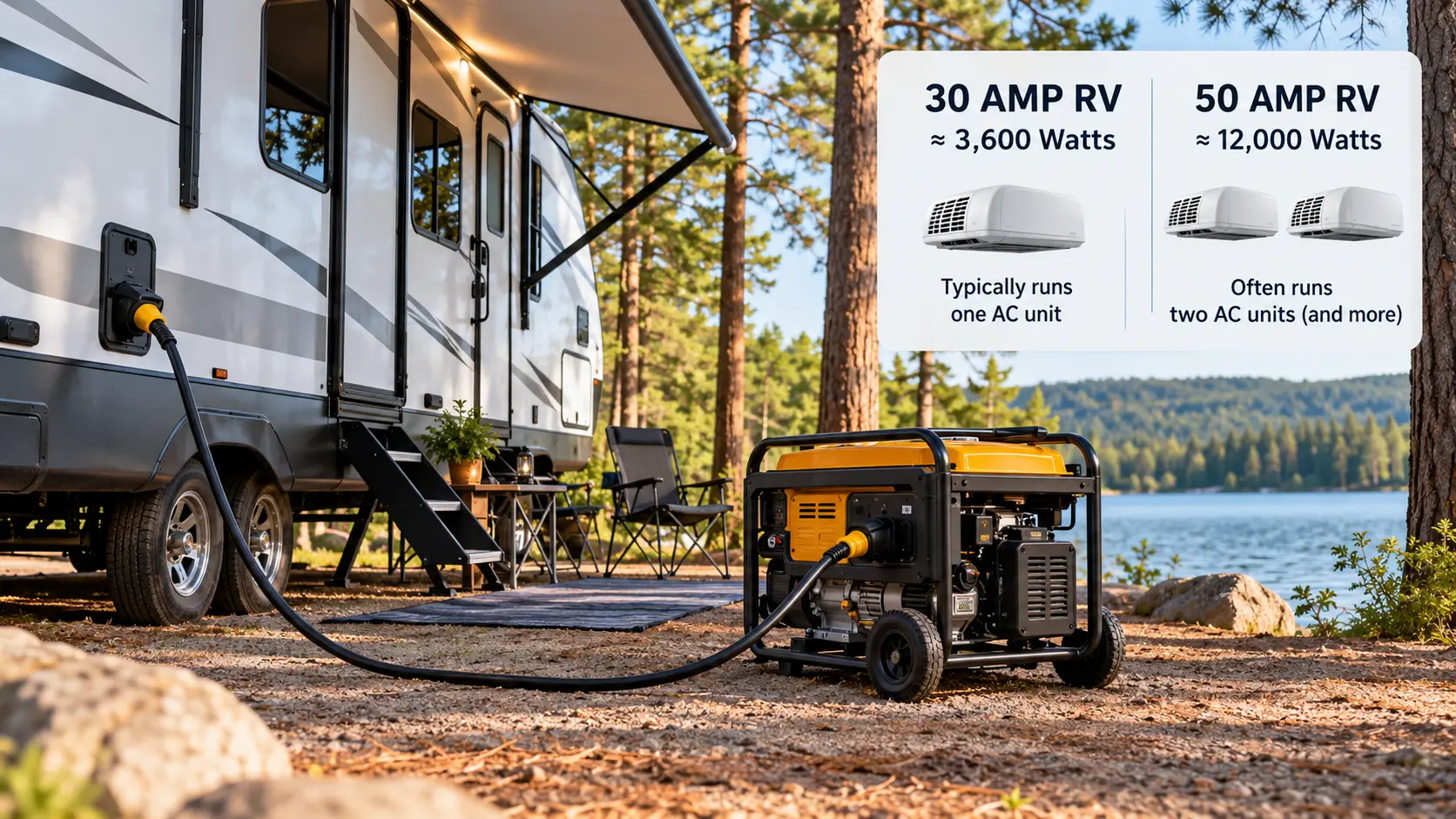
A 3,500-watt generator runs a refrigerator and a freezer, a furnace blower, or a sump pump, with room for lights. It rarely runs all three motor loads at once. MicroAir says a standard 13,500 BTU RV air conditioner typically needs at least 3,500 watts, so this size also covers one RV AC with few other loads.
Pick the loads that matter most and start the motors one at a time.
What can a 4,000 watt generator run?
A 4,000-watt generator runs a refrigerator, a furnace blower, lights and a TV together. Add a sump pump and the load gets tight. Cummins suggests 4,000 watts for a 30 amp RV, which tops out near 3,600 watts, in its RV generator sizing article.
For camper loads, see our camper and RV generator sizing guide.
What can a 6,500 watt generator run?
A 6,500-watt generator runs everything a 5,000-watt unit runs, with room for a second heavy load. That usually means a window air conditioner, a well pump, or a space heater on its own turn. Space heaters draw 1,250 to 1,800 watts.
Central air is still a stretch. It draws 2,000 to 4,000 watts running, plus a large compressor surge.
What can a 7,500 watt generator run?
A 7,500-watt generator is where whole-house coverage starts. Bob Vila’s sizing chart says a 7,500-watt unit covers a 2-ton air conditioner, the kitchen, a furnace, a sump pump and living areas. It does not cover a water heater, an office or a garage.
Treat that chart as an estimate. A load calculation by a licensed electrician sets the real size.
What can a 10,000 watt generator run?
A 10,000-watt generator runs a 3-ton air conditioner and adds an electric water heater to the 7,500-watt list. It does not cover an office or garage. A 10-kilowatt unit is the same size as 10,000 watts.
Generators above 10,000 watts, such as 13,000-watt units, land between the 10,000 and 18,000-watt rows of that chart. Size them to your actual loads.
What can common appliances do on a generator?
Appliance wattage varies by model, so the nameplate beats any chart. These ranges are published starting points.
| Appliance | Running watts | Fits on a 5,000 W generator? |
|---|---|---|
| Refrigerator / freezer | 600 to 800 (2,200 to start) | Yes |
| Sump pump | 800 to 1,500 | Yes |
| TV | 100 to 350 | Yes |
| Microwave | 625 to 1,200 | Yes, with other loads staggered |
| Washing machine | 750 to 1,150 | Yes, with other loads staggered |
| Space heater | 1,250 to 1,800 | Yes, as one of your biggest loads |
| Central AC | 2,000 to 4,000 | Only with very few other loads |
| Electric water heater | 3,000 to 4,500 | Only by itself |
| Electric dryer | 1,500 to 5,000 | Only by itself, at the top end |
| Electric oven | 5,000 | No, not with anything else |
The last column is a planning judgment built from the ranges, not a manufacturer rating.
Can a 5,000-watt generator run a well pump or furnace?
Yes, but not by plugging them in. A furnace and most well pumps are hard-wired. Michigan State University Extension lists gas furnaces at 400 to 2,000 watts and water pumps at 1,000 to 3,500 watts. It also says these loads cannot be plugged into most portable generators.
That MSU table dates from 1998. Newer models often run lower.
A licensed electrician connects these loads through a transfer switch. It involves your panel, a permit and an inspection.
Can a 5,000-watt generator run a welder?
It depends on the welder. Read the welder’s input rating on its nameplate and compare it to the generator’s running and surge ratings. A welder is a heavy, fluctuating load, so leave headroom.
Can a 5,000-watt generator run a house?
A 5,000-watt generator runs a house’s critical circuits, not the whole house. That means the refrigerator, furnace blower, sump pump, lights and a few outlets. A home with central air, an electric dryer or an electric water heater needs 7,500 watts or more.
Square footage does not set the answer. Heating fuel and big loads do. Two 2,000-square-foot homes can differ by 10,000 watts.
Critical circuits or the whole house?
A critical-circuits setup powers a short list of essentials on a smaller unit. A whole-house setup powers nearly everything. For a 5,000-watt generator, plan on critical circuits.
Should you choose a portable or standby generator at this size?
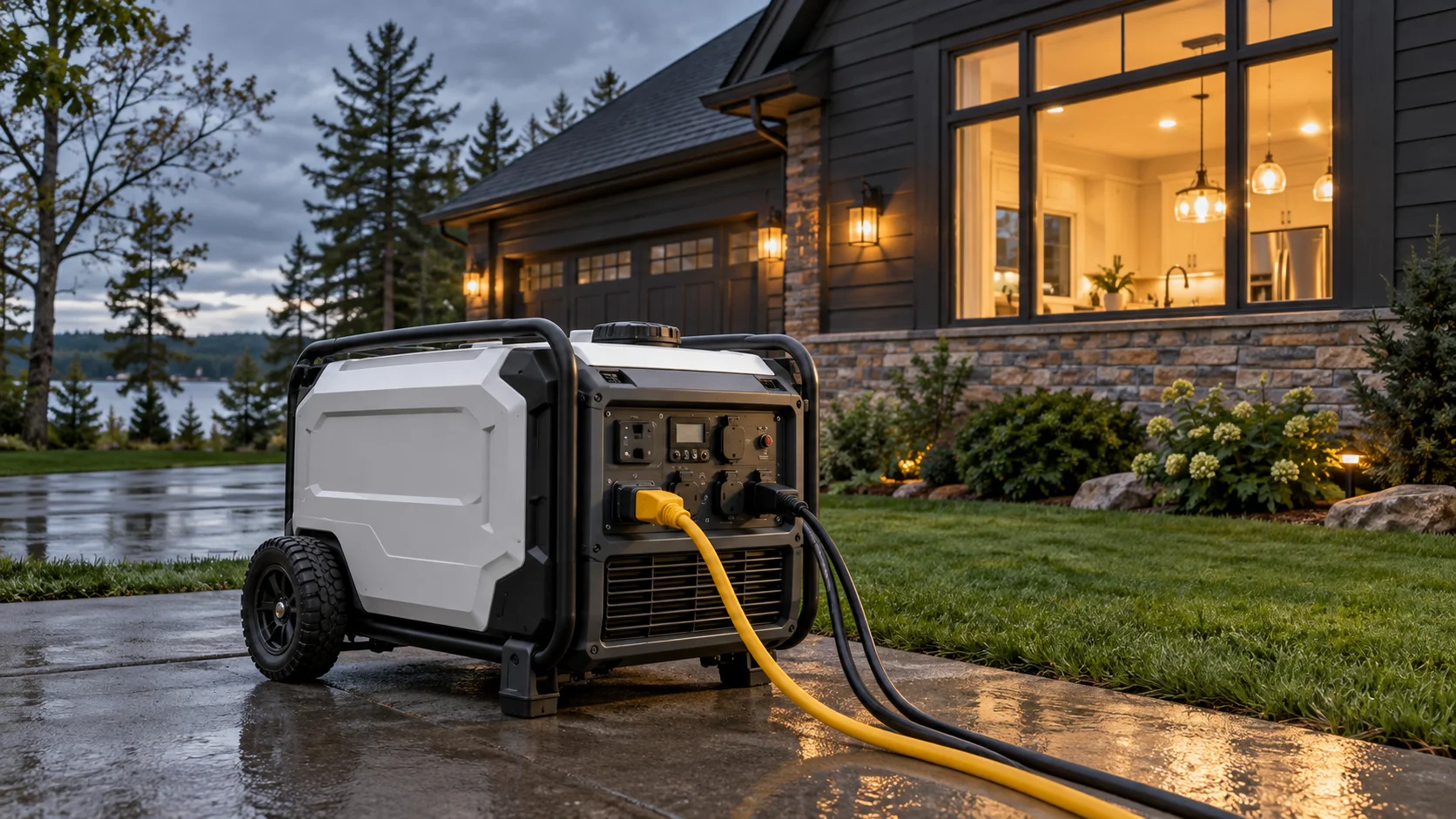
Choose portable for a few plug-in loads and standby for automatic, hard-wired power. A portable 5,000-watt unit is rolled out, fueled and connected by hand. A standby unit sits beside the home, connects through an automatic transfer switch and starts when the utility power fails.
Meyers Electric lists the Onan P5000iDF EFI, a 5,000-watt dual-fuel inverter generator with electronic fuel injection. We install Cummins standby systems for homes, small businesses, farms and municipal sites. Our post on a generator that starts automatically explains how standby units work.
How do you connect a 5,000-watt generator safely?
Plug a refrigerator or freezer directly into the generator with a heavy-duty, outdoor-rated cord. Connect a furnace or a hard-wired pump only through a transfer switch installed by a licensed electrician. Never plug a generator into a wall outlet.
Backfeeding a house panel sends power onto the utility lines. It can injure or kill a lineworker.
Where should you put the generator?
Outdoors, well away from doors, windows and vents. The U.S. Consumer Product Safety Commission says never to run a generator in a garage, basement or other enclosed space. See its portable generator safety alert.
The CPSC links portable generators to an estimated 765 non-fire carbon monoxide deaths from 2009 through 2019, per its carbon monoxide report. Put battery-powered CO alarms on every level.
What does Wisconsin change about what a generator can run?
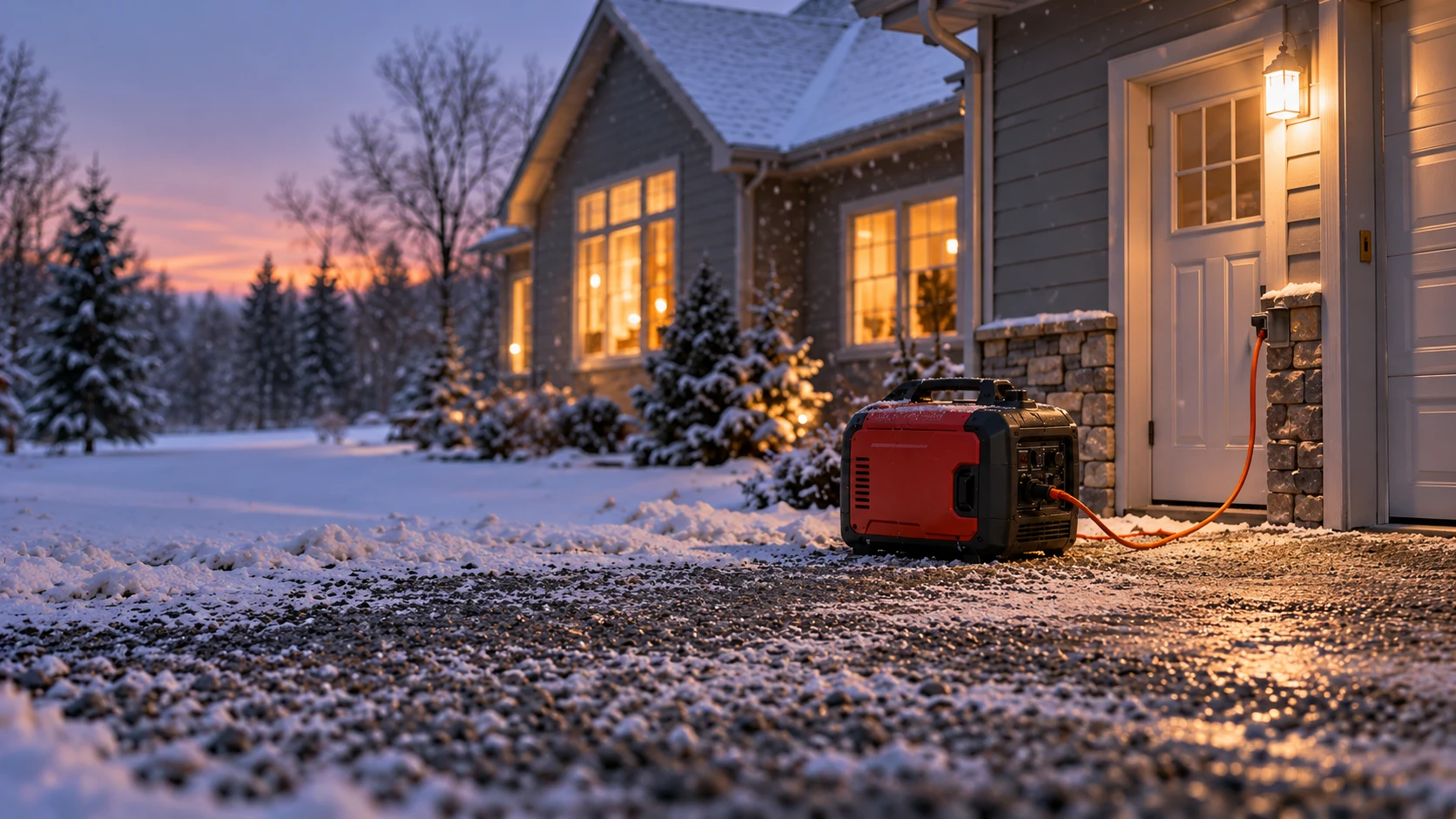
Wisconsin adds cold, long outages and rural loads. In January the furnace blower is not optional. A farm or lake home may also run a well pump, a sump pump and a second freezer at the same time. Those loads decide whether 5,000 watts is enough.
- Winter outages: Count the furnace blower and refrigerator first. Electric heat can add 5,000 watts or more and moves you to a larger unit.
- Well pumps: Rural homes without city water lose water when the power fails. A well pump is hard-wired and needs a transfer switch.
- Sump pumps: Spring thaw and heavy rain make this a critical load.
- Farm and cabin loads: Barn motors, ventilation and lake-property pumps need their own load list.
- Code: Wisconsin adopts the National Electrical Code (NEC) through SPS 316. NEC Article 702 covers optional standby systems like home generators.
- Utilities: Outage patterns depend on whether Xcel Energy, Barron Electric Cooperative or Rice Lake Utilities serves you.
Want power for your furnace and sump pump without extension cords?
Meyers Electric installs transfer switches and standby generators for homes, farms and small businesses across northwest Wisconsin. See our generator installation services or contact us in Rice Lake.
When should you call a licensed electrician?
Call one for any hard-wired load or any generator connected to your panel. That covers a furnace, a well pump, a hard-wired sump pump and a transfer switch. These jobs involve a permit and an inspection. Plugging a refrigerator into a portable generator is not that kind of work. Wiring a generator into your house is.
Keep the generator ready between storms. Our Meyers PowerGuard™ generator care plan covers annual inspections and testing for standby systems.
Frequently asked questions
Can a 5,000-watt generator run a whole house?
Not a typical one. A 5,000-watt unit runs critical circuits. Central air, an electric water heater and an electric dryer push the total past it. A whole-house setup usually starts at 7,500 watts.
Can a 5,000-watt generator run a refrigerator and a furnace in a Wisconsin winter?
Yes. A refrigerator runs near 700 watts and a gas furnace blower near 600, so both fit with room left. The furnace connects through a transfer switch. The refrigerator plugs in directly.
Will a 5,000-watt generator run a sump pump and a well pump?
Often yes, if you start them one at a time. Both are hard-wired and need a transfer switch. Check each nameplate for running and starting watts, because sizes vary widely.
Can you run a space heater on a generator?
Yes. Most space heaters draw 1,250 to 1,800 watts, so give the heater its own turn on the load. Never run a generator indoors to power a heater.
Can you run a microwave or dishwasher on a generator?
A microwave draws 625 to 1,200 watts and fits a 5,000-watt generator, if the other motors are idle.
Can I run a generator all night?
Yes, if it has fuel and you run it outdoors with a CO alarm inside. Check the unit’s rated run time at the load you plan to carry.
Does a Level 2 EV charger or a heat pump change what a generator can run?
Yes. Either one adds a large, steady load that can crowd a 5,000-watt generator. Tell your electrician so those circuits are counted or intentionally left off the backed-up list. See our post on EV charging station cost.