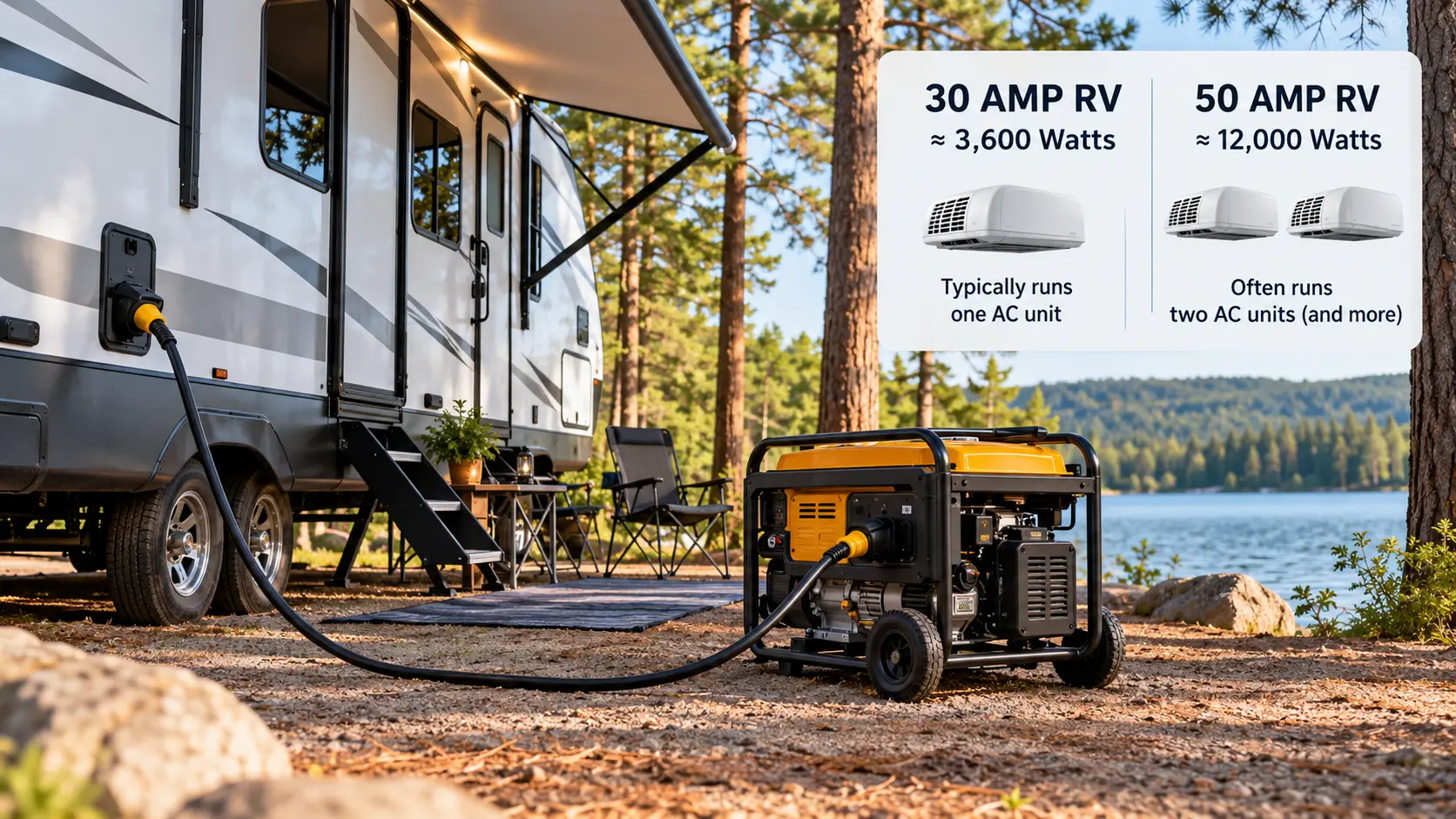

What size generator for a 30 amp RV? Plan on 3,500 to 4,000 watts if you run an air conditioner, because a 30 amp hookup maxes out near 3,600 watts. A 50 amp RV needs more: about 5,500 watts for two air conditioners, up to 12,000 watts for the full hookup. Meyers Electric helps Rice Lake and northwest Wisconsin campers, cabin owners and campgrounds size their power.
Key takeaways
- A 30 amp RV tops out near 3,600 watts. A 3,500 to 4,000 watt generator covers it, including one air conditioner.
- A 50 amp RV can draw up to about 12,000 watts. Two air conditioners usually call for 5,500 to 8,000 watts.
- The air conditioner sets the size. Its compressor pulls a startup surge of two to three times its running watts.
- A soft start device cuts that surge and lets a smaller generator run the same air conditioner.
- Run a generator outdoors, away from the camper. Connecting one to a cabin or building takes a licensed electrician.
Table of Contents
How many watts does a 30 amp RV need?
A 30 amp RV draws 3,600 watts at most. That is 120 volts times 30 amps. Cummins says a 3,600 watt generator matches that limit and suggests 4,000 watts for extra motor-starting power, per its RV generator sizing guide.
Most campers never hit the limit. The air conditioner and the microwave are the two big loads. Run them one at a time and a smaller unit can do the job.
What size generator for a 30 amp RV air conditioner?
A standard 13,500 BTU RV air conditioner typically needs a generator of at least 3,500 watts, according to MicroAir. The reason is the compressor. It pulls a startup spike that is often two to three times its running wattage.
Cummins lists 2,500 to 2,800 watts as the minimum for a 30 amp RV with AC. That works only when little else is on. Check the surge (peak) rating on the generator, not just the running rating.
Can a soft start let you use a smaller generator?
Yes. A soft start is a small module that eases the compressor on instead of slamming it on. MicroAir says its EasyStart cuts the startup surge by as much as 75%, and that a 13,500 BTU unit can then run on a 2,000 watt generator.
That is one maker’s claim for one product. Get the startup watts for your exact air conditioner before you buy a smaller generator.
What size generator for a 50 amp RV?
A 50 amp RV can draw up to about 12,000 watts, so the largest generators run 12,000 to 12,500 watts. Few campers use that much. A 50 amp rig with two air conditioners usually runs on 5,500 to 8,000 watts, based on Cummins’ ranges.
Size to your real loads. Count each air conditioner, then add the water heater, microwave and any other large appliance that runs at the same time.
What size generator for a 50 amp RV with 2 AC units?
Two 15,000 BTU air conditioners on a Class A coach fall in the 5,500 to 8,000 watt range, per Cummins. A fifth wheel with two air conditioners falls at 5,500 to 7,000 watts. A third air conditioner pushes the range to 10,000 to 12,500 watts.
Start the air conditioners one at a time. Two compressors starting together double the surge.
What generator size fits each RV type?
Generator size depends on RV type mainly because each type carries a different number of air conditioners. These ranges come from Cummins. Your equipment can change the answer, so treat them as a starting point.
| RV type | Air conditioners | Generator size |
|---|---|---|
| Class B van | 1 | 2,000 to 3,600 W |
| Class C | 1 | 2,800 to 4,000 W |
| Fifth wheel | 2 | 5,500 to 7,000 W |
| Class A | 2 (15,000 BTU each) | 5,500 to 8,000 W |
| Class A | 3 (15,000 BTU each) | 10,000 to 12,500 W |
What is the difference between a 30 amp and a 50 amp RV?
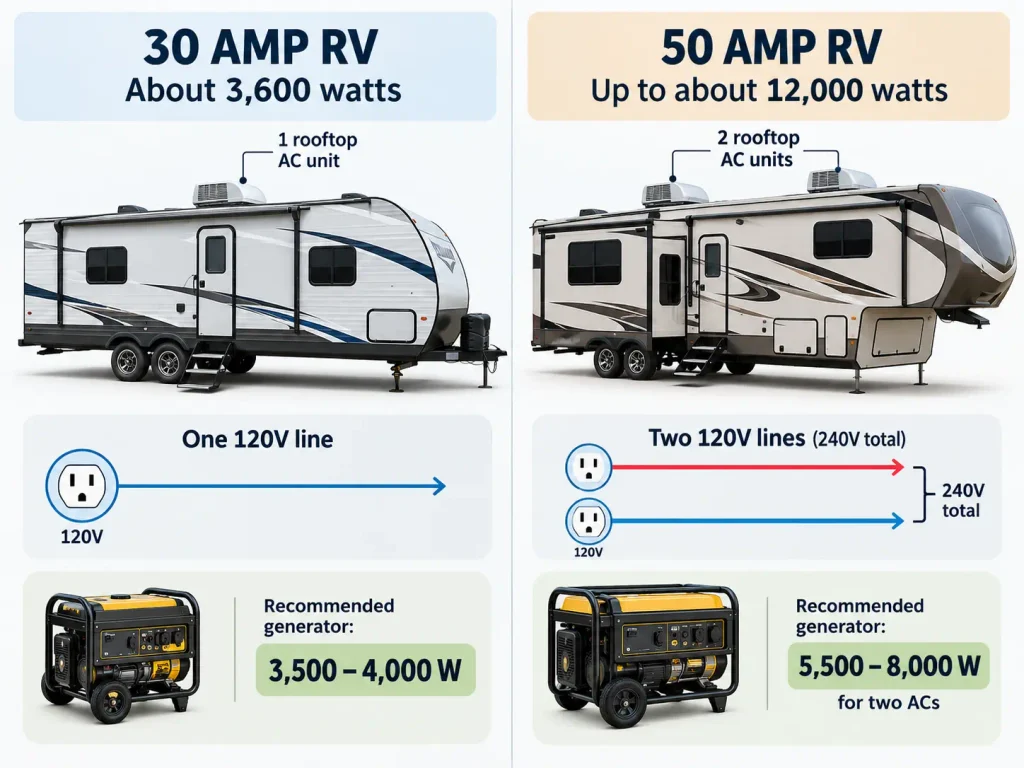
A 30 amp RV has a single 120 volt line and tops out near 3,600 watts. A 50 amp RV has two 120 volt lines and handles up to about 12,000 watts. The 30 amp rig is usually a travel trailer or small motorhome. The 50 amp rig is usually a large fifth wheel or Class A coach.
| 30 amp RV | 50 amp RV | |
|---|---|---|
| Maximum draw | about 3,600 W | up to about 12,000 W |
| Typical air conditioners | 1 | 2 or 3 |
| Typical generator | 3,500 to 4,000 W | 5,500 to 12,500 W |
| Typical rig | Travel trailer, small motorhome | Large fifth wheel, Class A |
How many watts do common camper appliances use?
Camper appliances range from a few watts to more than 2,000. Cummins publishes typical ranges. Read the label on your own appliances, because models vary, and appliances with motors or compressors draw more at startup.
- Air conditioner (13,500 to 15,000 BTU): 1,200 to 2,400 W each
- Refrigerator: 400 to 1,000 W
- Microwave: 750 to 1,500 W
- Coffee maker: 900 to 1,200 W
- Toaster: 800 to 1,400 W
- TV: 43 to 600 W
- Laptop: 20 to 50 W
Add up only the items that run at the same time. That total, plus the startup surge of the largest motor, is your target wattage.
What can a 2,500, 3,500 or 5,000 watt generator run in a camper?
Match the wattage to your hookup and your air conditioner. A 2,500 watt unit handles small loads and, with a soft start, one air conditioner. A 3,500 watt unit clears the usual 13,500 BTU AC minimum. A 5,000 watt unit covers a full 30 amp RV.
- 2,500 watts: Lights, a fridge, chargers and a TV. One air conditioner only with a soft start.
- 3,500 watts: One 13,500 BTU air conditioner plus basics on a 30 amp rig.
- 5,000 watts: A 30 amp RV at its 3,600 watt limit. Short of the 5,500 watt starting point for two air conditioners on a 50 amp rig.
What size generator for a pop-up camper?
A pop-up camper needs less than a hard-sided RV because most have no air conditioner. Add up the labeled watts of your lights, fan, fridge and chargers, then buy a generator that clears that total with room to spare. A small inverter generator, such as the 2,500 watt class, suits light-load camping.
Meyers Electric lists the Onan P2500i, a 2,500 watt gasoline inverter generator, on our generator installation page.
Should you buy an inverter or a conventional generator for an RV?
An inverter generator is a portable unit that makes clean, steady power and runs quietly. A conventional generator is louder and costs less per watt. Inverters suit campgrounds with quiet hours and sensitive electronics. Conventional units suit large loads.
Large 50 amp rigs often need more output than a typical inverter delivers. Check the generator’s maximum output against your loads before you buy. A mismatched unit can also stress electronics, as our post on a generator causing power surges explains.
How do you connect an RV to a generator safely?
Shore power is utility power from a campground pedestal. A generator replaces it. A 30 amp RV plugs into the generator’s 30 amp RV outlet, and a 50 amp RV into a 50 amp outlet. Use only cords and adapters made for that job.
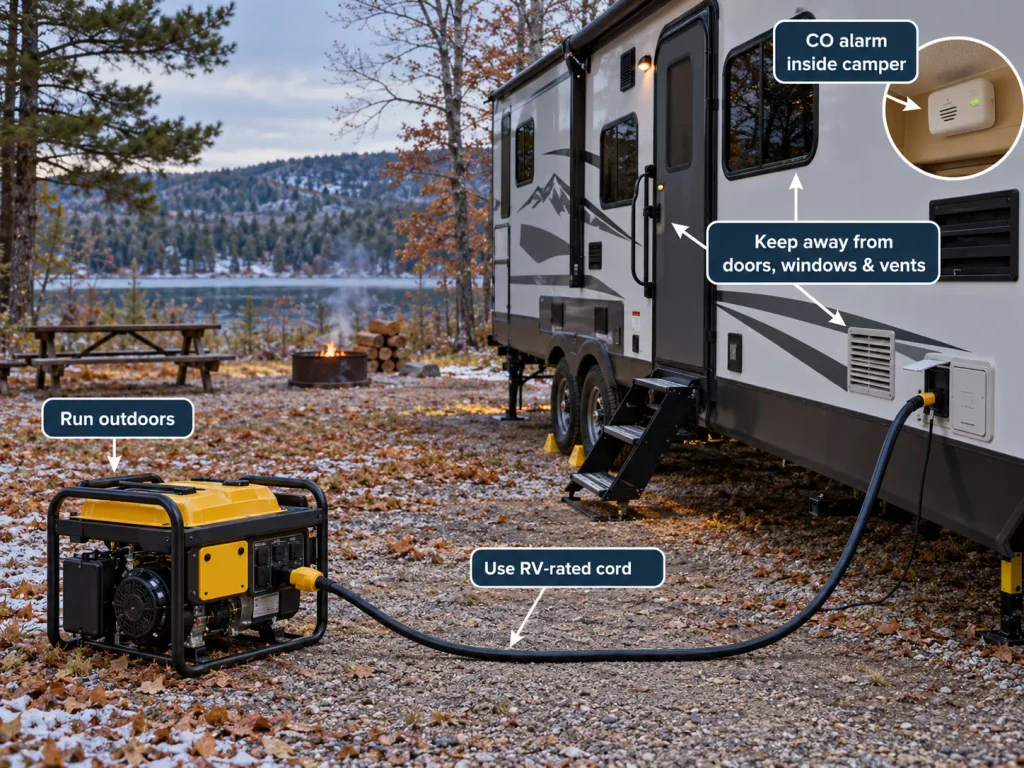
Do not cut, splice or rewire cords. Never plug a generator into a house outlet or a cabin panel. That backfeeds the utility lines and can injure a line worker. Connecting a generator to a building takes a transfer switch installed by a licensed electrician.
Where should you put the generator?
Outdoors, away from the camper. The U.S. Consumer Product Safety Commission says to keep generators well away from doors, windows and vents, and never to run one in a garage or other enclosed space. See its portable generator safety alert.
Put a battery-powered carbon monoxide (CO) alarm in the camper. CO is an odorless gas that builds up fast in a small space.
What does Wisconsin add to camper generator sizing?
Wisconsin adds cold nights, lake-property pads and storm outages. Cold weather adds heat loads: a propane furnace still runs a blower fan, and an electric space heater can add about 1,500 watts. Count both in your sizing.
- Lake and cabin pads: An RV on a lake property often runs off a pedestal or a generator. A permanent pedestal or RV inlet is electrician work.
- Storm outages: Some owners use a camper as backup shelter. Size the generator to the camper’s loads, not the house’s.
- Campgrounds: Quiet hours and generator rules vary by park. Ask before you arrive.
- Code: Wisconsin adopts the National Electrical Code (NEC) through SPS 316. The last published summary lists the 2017 NEC (ICC). NEC Article 551 covers recreational vehicles and RV parks.
Planning power for a camper pad or campground?
Meyers Electric wires campsite pedestals, restroom facilities and backup power across northwest Wisconsin. See our campground and recreation electrical work and generator installation services, or contact us in Rice Lake.
When should you call a licensed electrician?
Call one for any permanent hookup: a 30 or 50 amp pedestal, an RV inlet on a cabin, a transfer switch, or backup power for a campground. These jobs involve a panel, a permit and an inspection. Plugging a portable generator into your own camper is not that kind of work. Wiring one into a building is.
Meyers Electric handles pedestal wiring, generator hookups and transfer switches. If your panel is already crowded, read our guide on an overloaded electrical panel first.
FAQs
Can you run a generator while driving an RV?
Never run a portable generator inside, on or attached to a moving vehicle. Exhaust and fuel risks are too high. A generator built into a motorhome follows its maker’s rules, so read the owner’s manual.
Will a 2,200 or 2,500 watt generator run an RV air conditioner?
Only with a soft start. A standard 13,500 BTU unit typically needs at least 3,500 watts, according to MicroAir. With a soft start, the same unit can run on a 2,000 watt generator. Price a soft start first.
Will a 3,500 or 5,000 watt generator run a camper?
Yes for a 30 amp camper. A 3,500 watt unit runs one air conditioner and the basics, with little room for extras. A 5,000 watt unit covers the full 3,600 watt hookup. For a 50 amp camper with two air conditioners, 5,000 watts falls short of the 5,500 watt starting point.
How much does a generator for an RV cost?
Cost depends on wattage, fuel type and whether the unit is portable or installed. We do not list a price here. Call us for a quote on an installed setup.
What is the best generator for RV use?
The one that fits your hookup and your air conditioner. For a 30 amp rig, look at 3,500 to 4,000 watts, ideally a quiet inverter design. For a 50 amp rig, size to your loads first. Our generator installation team can match a unit to your loads.
Can I run a generator to heat my camper on a cold Wisconsin night?
You can power an electric heater or the furnace blower from a generator. Run it outdoors, far from the camper, and keep a CO alarm inside. Never run one in a garage or shed to keep it warm. The CPSC says never to run a generator in an enclosed space.